
Why Search Is Changing and What It Means for Your Business
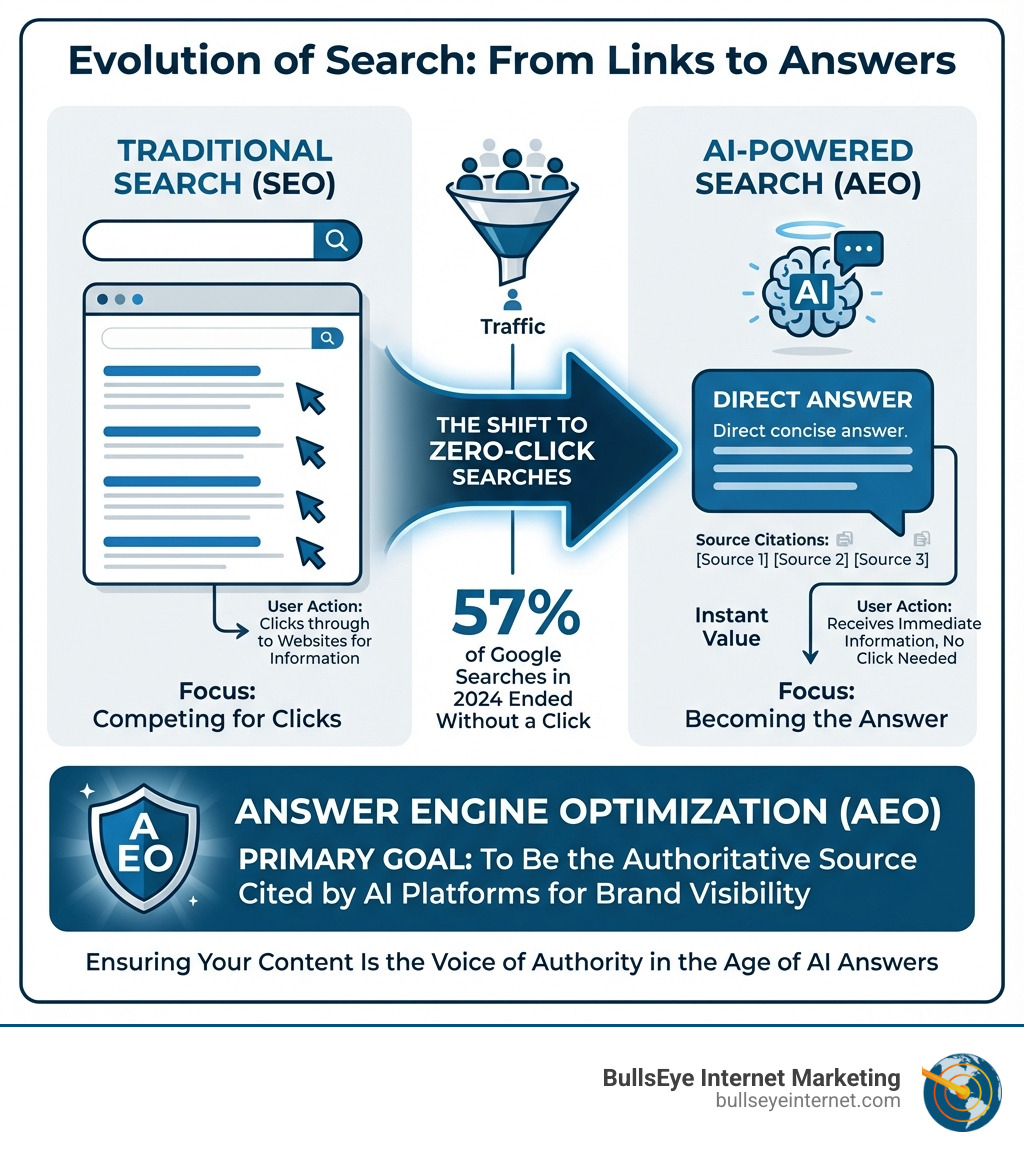
What is AEO? Answer Engine Optimization (AEO) is the practice of optimizing your content to be selected and featured as the direct answer in AI-powered search tools like ChatGPT, Google AI Overviews, and Perplexity. Instead of competing for clicks from a list of blue links, AEO focuses on becoming the authoritative source that AI platforms cite when answering user questions.
Quick Answer:
- AEO stands for: Answer Engine Optimization
- Primary Goal: To make your content the direct answer AI tools provide, not just a link in search results
- Key Difference from SEO: SEO aims for clicks and traffic; AEO aims to be the answer itself
- Why It Matters Now: Over 57% of Google searches in 2024 ended without a click, and by 2026, traditional search volume is predicted to drop 25% as users shift to AI chatbots
The rules of search are changing fast. When someone asks ChatGPT, Google’s AI Overview, or Perplexity a question, they get an answer, not a list of websites to click through. This shift is reshaping how customers find businesses like yours.
Consider this: Stack Overflow’s traffic dropped 14% in March 2023 and 18% in April 2023 following ChatGPT’s launch. Meanwhile, NerdWallet grew revenue by over 35% in 2024 while their website traffic decreased by 20%. The message is clear—users are shopping differently, and businesses need to show up where the questions are being answered.
If your content isn’t built to be the answer, you won’t even be in the conversation. That’s what AEO is all about: ensuring your brand is the voice of authority when AI tools respond to potential customers.
I’m Ronnie Katz, founder and CEO of BullsEye Internet Marketing, and I’ve been helping businesses steer online visibility since 2006. Understanding what is AEO and how to implement it has become critical for my clients who want to maintain their competitive edge as search evolves beyond traditional Google rankings.
What is AEO (Answer Engine Optimization) and Why Does It Matter?
In the rapidly evolving landscape of digital marketing, we’re witnessing a fundamental shift in how people access information. Gone are the days when a simple list of ten blue links was the only way to find what you needed. Today, AI Overviews, Featured Snippets, and voice search assistants are providing direct, concise answers, often without a single click to a website. This is where what is AEO truly shines, becoming the new frontier for online visibility.
Answer Engine Optimization (AEO) is the strategic process of creating and structuring your online content so that AI-powered systems can easily understand, extract, and use it to directly answer user queries. It’s about optimizing for the answer, not just the click. As users increasingly expect immediate, direct information, our digital marketing strategies must evolve to meet these new expectations.
The Primary Goal of AEO
The primary goal of AEO is straightforward: to position your content as the definitive answer for conversational queries. Instead of merely appearing in a list of search results, we want your brand to be the answer that AI platforms deliver. This means crafting content that is so clear, concise, and authoritative that AI models choose it to directly address a user’s question, whether through a Google AI Overview, a ChatGPT response, or a voice search result.
Think of it this way: our aim is to make your content the final destination for information, changing your brand into a trusted source that AI systems rely on. This not only boosts your brand’s authority but also ensures your message is heard in an increasingly “zero-click” world.
Why AEO is Crucial in Today’s Search Landscape
The statistics paint a clear picture: the way users search is changing dramatically, and our strategies must adapt. According to a recent Gartner prediction, traditional search engine volume is expected to drop 25% by 2026, with search marketing losing market share to AI Answer Engines like ChatGPT and Perplexity. This means a significant portion of organic traffic—potentially 25%—will shift to AI chatbots and other virtual agents.
Consider these impactful figures:
- Over 57% of Google searches in 2024 ended without a click. This indicates a growing preference for direct answers over navigating through websites.
- 80% of Gen Z users prefer asking questions via voice or AI. This demographic is driving the shift towards conversational and AI-driven search.
- Pages that earn a featured snippet receive 31% more average traffic than the next organic result, highlighting the power of direct answers.
- 75% of voice search results come from the top 3 organic positions, emphasizing the importance of being the authoritative source.
The rise of AI-powered search isn’t just a trend; it’s a fundamental change. For businesses in Florida and across the United States, maintaining visibility in these new AI channels is no longer optional. The success of companies like NerdWallet, which saw revenue growth despite a decrease in website traffic, underscores that users aren’t shopping less, they’re simply shopping differently. By embracing AEO, we can ensure your brand is present and authoritative where your customers are asking questions, securing your competitive advantage.
AEO vs. SEO vs. GEO: Understanding the Key Differences
The world of search optimization is rapidly evolving, bringing with it a new alphabet soup of acronyms: SEO, AEO, and GEO. While they all aim to improve online visibility, their approaches, goals, and metrics can differ significantly. Understanding these distinctions is key to developing a comprehensive digital strategy for your business.

How AEO Differs from Traditional SEO
Traditional Search Engine Optimization (SEO) has long focused on ranking whole web pages high in search engine results pages (SERPs) for specific keywords, primarily to drive clicks to your website. We measure success in terms of rankings, impressions, and click-through rates.
What is AEO, on the other hand, is a different beast entirely. It shifts our focus from optimizing entire pages for search algorithms to optimizing specific “content chunks” for AI retrieval systems. Here’s how they diverge:
- Content Chunk Optimization vs. Whole Page: With SEO, we optimize an entire page with keywords, internal links, and comprehensive content. For AEO, we’re often optimizing smaller, direct answers—a paragraph, a list, or a short FAQ response—that AI can easily extract.
- Probabilistic Responses vs. Ranked Listings: Traditional SEO aims for a predictable ranking in a list of results. AI-generated answers are more probabilistic; the AI “predicts the next most likely word” or synthesizes information, leading to varied responses that may or may not cite your content directly.
- Infinite Query Variations vs. Targeted Keywords: While SEO still relies on researching and targeting specific keywords, AI answers often address “infinite query variations”—more natural, conversational questions that can be phrased in countless ways.
- Reduced Reliance on Backlinks: While backlinks remain crucial for overall domain authority in SEO, their direct influence on whether an AI selects a content chunk for an answer is less clear. AI prioritizes the quality, relevance, and directness of the answer itself.
- E-E-A-T Importance: Experience, Expertise, Authoritativeness, and Trustworthiness (E-E-A-T) have always been important for SEO, but they are absolutely critical for AEO. AI models are trained on vast datasets and are designed to identify and prioritize authoritative, fact-based information. If your content lacks strong E-E-A-T, it’s less likely to be chosen as the definitive answer.
What is AEO’s Relationship to Generative Engine Optimization (GEO)?
The terms AEO, GEO (Generative Engine Optimization), and sometimes GSO (Generative Search Optimization) are often used interchangeably, but there’s a nuanced distinction we like to make.
- AEO is about being the answer. It focuses on optimizing content to appear directly in AI Overviews, featured snippets, and voice results. We want your content to be the definitive, scannable answer to common questions.
- GEO is about being part of the answer. It focuses on ensuring your brand, product, or service is accurately and favorably represented in AI-generated responses, even if it’s not the primary source cited. This often involves optimizing for broader queries where AI synthesizes information from multiple sources.
Think of it this way: AEO is like winning the gold medal for a specific question, while GEO is about consistently being on the podium, cited as a reputable source within a larger AI-generated summary.
Here’s a quick comparison:
| Feature | SEO (Search Engine Optimization) | AEO (Answer Engine Optimization) | GEO (Generative Engine Optimization) |
|---|---|---|---|
| Goal | Drive traffic via organic search rankings (links) | Be the direct answer in AI features (snippets, AI Overviews) | Be cited/mentioned in AI-generated summaries (part of answer) |
| Tactics | Keyword research, link building, on-page optimization | Structured data, Q&A format, concise answers, E-E-A-T | Brand marketing, PR, authority building, content comprehensiveness |
| Metrics | Rankings, traffic, impressions, CTR | Featured snippet wins, AI Overview presence, voice search answers | Brand mentions, sentiment in AI responses, citation frequency |
| Query Type | Keyword-based, specific searches | Short, direct questions | Broad, conversational, complex questions |
| Output | List of blue links | Direct answer (text, list, table) | Synthesized summary, often with citations |
The Benefits of Achieving AEO for Your Business
For businesses in Florida and across the US, mastering AEO offers a suite of compelling benefits that translate directly into growth and competitive advantage:
- Increased Brand Visibility: When 57% of searches are zero-click, being the direct answer means unparalleled visibility. Your brand becomes synonymous with the solution.
- Improved Authority and Trust: When AI systems consistently cite your content, it positions your brand as a leading authority in your industry. This builds immense trust with potential customers.
- Capturing Zero-Click Traffic: Even if users don’t click through, seeing your brand as the source of truth in an AI answer still drives awareness and influences decision-making. These are highly qualified “impressions.”
- Voice Search Dominance: With 80% of Gen Z users preferring voice or AI, and 75% of voice search results coming from the top 3 organic positions, AEO is critical for winning in the voice search arena.
- Higher Quality Leads: Users who find your brand through direct AI answers are often further along in their decision-making process, leading to more qualified inquiries and sales opportunities for your business.
- Competitive Advantage: As this shift is still underway, early adopters of AEO gain a significant lead over competitors who are still solely focused on traditional SEO. We help our clients stay ahead of the curve.
Essential Components of a Winning AEO Strategy
Implementing an effective AEO strategy requires a nuanced approach, blending traditional SEO best practices with new techniques custom for AI systems. It’s about ensuring your content is not only informative for humans but also easily digestible and authoritative for machines.
Key Strategies for Optimizing Content for AEO
Our goal with AEO is to make your content the perfect candidate for an AI-generated answer. Here’s how we approach it:
- Write Short, Fact-Based Answers: AI models prefer concise, unambiguous information. We focus on providing direct, factual answers to common questions.
- Lead with the Answer: For any question you’re addressing, we place the most direct, 1-3 sentence answer right at the top of the content. This makes it incredibly easy for AI to extract.
- Follow Up with Supporting Detail: After the initial concise answer, we provide additional context, explanations, bullet points, and examples to ensure comprehensiveness for human readers.
- Use a Q&A Format with H2s: Structuring your content with clear H2 headings for questions (e.g., “What is AEO?”) and then providing the answer immediately below is highly effective. This mirrors how AI processes information.
- Format for Scannability: AI, like humans, appreciates well-organized content. We use lists, bolding, short paragraphs, and clear subheadings to make content easy to skim and understand.
- Focus on Transactional and Informational Queries: We identify the specific questions your target audience asks, both when seeking information and when looking to make a purchase. Tools like Google’s “People Also Ask”, AnswerThePublic, and AlsoAsked are invaluable for this research.
- Prioritize Clarity and Directness: Ambiguity is the enemy of AEO. We ensure your content is crystal clear, leaving no room for misinterpretation by AI models.
The Critical Role of Structured Data and Schema Markup
Structured data, particularly schema markup, is the secret sauce for AEO. It’s code that we add to your website to help search engines and AI platforms better understand the context and meaning of your content. Think of it as translating your content into a language AI can instantly comprehend.
For AEO, we heavily use specific schema types:
- FAQPage Schema: Ideal for pages with a list of frequently asked questions and their answers. This tells AI, “Hey, here are direct questions and direct answers!”
- HowTo Schema: Perfect for step-by-step guides. This helps AI understand the sequence of actions, making your content a prime candidate for “how-to” snippets and AI Overviews.
- QAPage Schema: Used for pages where a single question is asked and multiple answers are provided (e.g., forum pages), though less common for direct answer optimization.
By implementing these schema types, we make your content “machine-digestible.” This means AI can quickly identify the key questions and their corresponding answers, making your content “snippable” and highly likely to be featured as a direct response. It’s like giving the AI a perfectly organized cheat sheet.
Practical Steps to Start Implementing What is AEO
Ready to dive into AEO for your business? Here are the practical steps we take to get started:
- Conduct a Content Audit: We begin by reviewing your existing website content to identify pages that already answer common questions or can be easily optimized for AEO.
- Conversational Question Research: Using tools like Google’s “People Also Ask,” AnswerThePublic, and AlsoAsked, we uncover the exact questions your target audience is asking. We also monitor social media platforms like Reddit and TikTok to understand natural language queries.
- Competitor Analysis: We analyze what your competitors are doing in AI Overviews and featured snippets. What content are AI platforms citing for their queries? This helps us understand what works and identify opportunities.
- Test Queries on AI Platforms: A simple yet powerful step: we directly ask ChatGPT, Perplexity, and Google AI Overviews questions relevant to your business. This shows us how these platforms currently respond and where your brand might fit in.
- Create an XML Sitemap: Ensuring your website has a clean, up-to-date XML sitemap helps AI crawlers easily find and index all your valuable content.
- On-Site Optimization:
- Findability: Ensure your site is technically sound for crawling and indexing.
- Content Improvement: Refine existing content and create new content focusing on direct answers, Q&A formats, and comprehensive yet concise information.
- Schema Implementation: Apply
FAQPage,HowTo, and other relevant schema markup to clearly label your answers. - Internal Backlinks: Build a strong internal linking structure to reinforce content authority and findability.
- Off-Site Optimization: While less direct than for SEO, off-site factors still contribute to overall authority. We continue to build high-quality backlinks, optimize local listings (crucial for local businesses in Florida!), and maintain active, informative social media profiles.
AEO in Action: Platforms, Measurement, and Future-Proofing
Understanding what is AEO is one thing; seeing it in action and measuring its impact is another. As AI continues to integrate into our daily lives, we need clear strategies for engaging with these platforms and tracking our success.
How AEO Applies to Different AI Platforms
While the core principles of AEO remain consistent, each AI platform has its nuances:
- Google AI Overviews: This is Google’s direct integration of generative AI into search results. Our AEO efforts here focus on structured data, clear answers in response to both informational and transactional queries, and strong E-E-A-T signals to earn a spot in these prominent answer boxes.
- ChatGPT: Initially, ChatGPT relied on its training data. However, as Alexis Rylko finded, ChatGPT now often uses Google search results to inform its answers, even mirroring the citation order. This means strong Google visibility (both SEO and AEO) can influence ChatGPT’s responses. We optimize for both base generation (influencing the training model) and the web search component (citations).
- Perplexity: This AI search engine is known for providing detailed answers with clear citations. Optimizing for Perplexity involves providing comprehensive, authoritative content that is easy to cite.
Only ~11% of domains are cited by both ChatGPT and Perplexity, and even less by Google AI Overviews and Copilot. This highlights the need for custom AEO efforts. We also consider “fan-out queries”—variations of prompts users might search for—to ensure your content addresses a wide range of related questions. Optimizing for AI training data is a long-term play, relying on consistent brand marketing and PR to establish your authority in your industry.
How to Measure the Success of Your AEO Efforts
Measuring AEO success can be more complex than traditional SEO, given the probabilistic nature of AI responses and the current lack of dedicated, standardized tools. However, we employ several strategies:
- Referral Traffic Tracking: We monitor referral traffic from AI platforms using Google Analytics. While it might not always be a direct click-through, any traffic from these sources is a strong indicator of visibility.
- Brand Mention Monitoring: We track how often your brand, products, or services are mentioned in AI-generated answers, even if they aren’t direct citations. This indicates brand awareness within the AI ecosystem.
- Citation Tracking: We actively monitor which of your pages and content pieces are cited by AI platforms like Perplexity and Google AI Overviews.
- Visibility Scores: While still emerging, some third-party tools offer “visibility scores” within AI answer engines.
- Sentiment Analysis: Beyond just mentions, we analyze the sentiment surrounding your brand in AI responses to ensure positive and accurate representation.
Due to the variety of prompts and answers from AI engines, tracking can be an approximation. Our focus is on identifying overall trends and ensuring your brand’s consistent presence and accurate representation in these critical new channels.
Main Challenges and How to Prepare for the Future of What is AEO
The journey into what is AEO is not without its problems. Here are some of the main challenges we face and how we prepare for the future:
- Tracking Performance Difficulty: The biggest challenge is the lack of specific webmaster tools or standardized reporting from AI platforms. Unlike Google Search Console for SEO, there isn’t a dedicated “AI Overview Console” that clearly shows impressions, clicks, or citations. This requires us to be creative and diligent in our tracking methods.
- Securing Internal Support: Implementing AEO often requires additional investment in content creation and technical optimization. We work closely with our clients to demonstrate the clear ROI and necessity of these efforts.
- Variety of Prompts and Answers: The sheer number of ways users can phrase questions, and the variability in AI responses, makes it hard to optimize for every single instance. We focus on core questions and authoritative, comprehensive answers.
- AI Training Data Lag: It can take time for AI models’ training data to update (sometimes up to eight months). This means our AEO efforts might not show immediate results within the generative core of an AI, requiring patience and a long-term perspective.
To prepare for the evolving future of AEO, we recommend:
- Focus on Unique Value: AI models are less likely to cite generic content. We help you produce original, authoritative, and proprietary information that stands out.
- Information Density: Be concise and get to the point. AI rewards content that provides clear, specific details (dates, statistics, entities) without unnecessary verbosity.
- Stay Updated on AI Developments: The AI landscape is changing almost daily. We dedicate time to researching updates from Google, OpenAI, and other key players to adapt our strategies.
- Don’t Panic, Adapt: As the Shopify team notes, “You don’t need to panic and upend your current strategy; keep doing what you’re doing for the most part regarding AEO.” Many AEO best practices align with good SEO and content strategy. We simply refine and improve them for the AI era.
AEO: A Strategic Imperative for Growth – BullsEye Internet Marketing
The shift from traditional search links to direct AI-generated answers is one of the most significant changes in digital marketing we’ve seen. Understanding what is AEO is no longer a niche concern; it’s a strategic imperative for any business looking to maintain and grow its online visibility.
We’ve explored how AEO differs from traditional SEO and GEO, focusing on being the definitive answer rather than just a link. We’ve digd into the crucial strategies, from crafting concise, fact-based content and leveraging structured data to navigating the complexities of AI platforms and measurement.
At BullsEye Internet Marketing, we believe a proactive AEO strategy is essential for businesses in Florida and across the United States. It’s how you ensure your brand isn’t just found, but trusted, cited, and ultimately, chosen by the next generation of consumers.
