
The Shift from Traditional Search to Generative Answer Engines
Specialized ai visibility services deliver multi-engine prompt auditing, AI crawler governance, advanced entity schema validation, and citation-first content engineering to ensure B2B brands are cited and recommended by conversational answer engines. By tracking prompt query volume, brand sentiment, and knowledge graph integration across generative models, these services position enterprise solutions directly inside AI-generated vendor shortlists.
The way enterprise decision-makers locate vendor partners has evolved. For over two decades, search engine marketing focused on earning positions across a standard list of blue links. Today, The Ultimate Guide to Generative Engine Optimization and AI Search Visibility highlights how artificial intelligence synthesizes multiple web sources into direct, conversational answers.
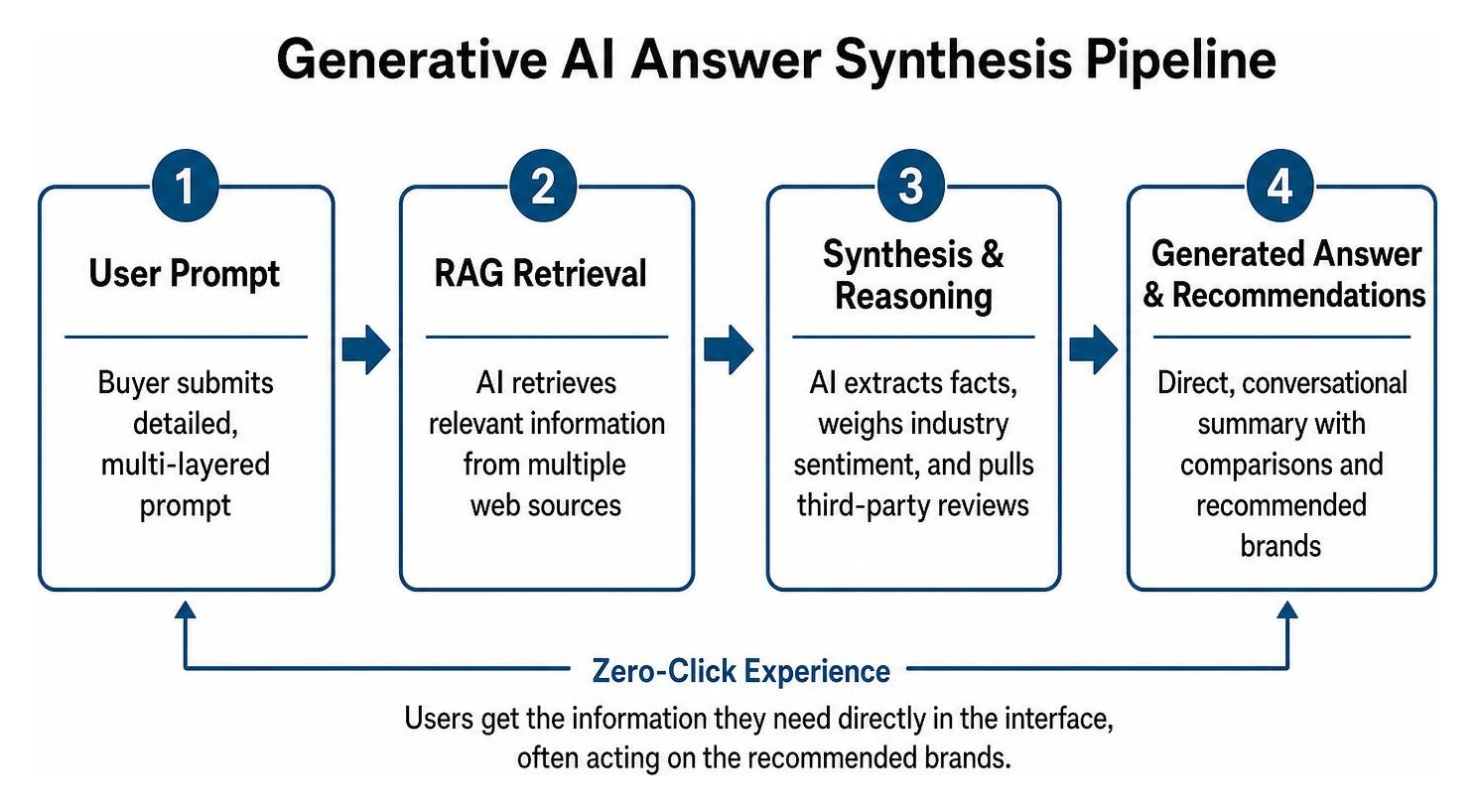
Instead of typing short keywords into a search box, buyers submit detailed, multi-layered prompts. Every day, OpenAI receives billions of prompts across ChatGPT from over 190 million users, reflecting a fundamental behavioral change across research workflows.
Traditional search engines require the user to open multiple tabs, evaluate individual landing pages, and compile their own comparison tables. Generative answer engines complete that synthesis instantly. They extract facts, weigh industry sentiment, pull third-party review data, and output an authoritative summary directly in the interface.
This evolution has accelerated zero-click experiences. When an AI answer engine provides an exhaustive, comparative answer, the searcher frequently acts on the specific brands mentioned without scrolling further. If your company is not referenced within the synthesized text or cited as a primary source, you are completely omitted from the buyer’s evaluation process.
GEO vs. AEO: Understanding the Strategic Distinction
To capture generative traffic, marketers must recognize the difference between Generative Engine Optimization (GEO) and Answer Engine Optimization (AEO). While both disciplines prioritize conversational discoverability, their execution paths address distinct technical mechanics.
Our comprehensive breakdown of Answer Engine Optimization AEO GEO LLM SEO defines the exact operational boundaries:
- Answer Engine Optimization (AEO): Focuses on providing direct, factual, and highly structured data to satisfy specific, immediate informational queries. It targets voice assistants, featured snippets, and deterministic Q&A engines by aligning with entity markup and clear question-and-answer schemas.
- Generative Engine Optimization (GEO): Targets large language models that generate multi-faceted, synthetic paragraphs. GEO optimizes for citation authority, semantic context, co-occurrence with industry benchmarks, brand sentiment, and retrieval-augmented generation (RAG) inclusion across generative platforms.
Why Enterprise B2B Brands Invest in AI Visibility Services
Enterprise buyers no longer perform simple product searches; they ask AI models to build comprehensive vendor comparisons, analyze pricing trade-offs, and recommend solutions tailored to specific corporate constraints. When an AI platform responds to these nuanced prompts, it acts as an automated consultant.
When partnering with a dedicated LLM SEO agency, B2B organizations secure representation during the critical consideration phase. Earning consistent placement across AI-generated shortlists accelerates sales velocity, shortens enterprise procurement cycles, and generates qualified inbound inquiries from prospects who have already reviewed an AI-generated business case for your product.
Core Deliverables of Specialized AI Visibility Services
Engaging specialized providers requires moving beyond theoretical advice. Real generative growth relies on technical precision, entity authority, and verifiable source tracking.
As outlined in A Comprehensive Guide to AI Visibility SEO LLM Optimization Strategies, managed engagements must deliver measurable interventions across technical, content, and data frameworks.
| Deliverable Category | Traditional SEO Agency Focus | Specialized AI Visibility Services Deliverable |
|---|---|---|
| Tracking & Auditing | Google SERP rank tracking for static keywords | Multi-engine prompt auditing, Prompt Query Volume (PQV) tracking, and citation mapping |
| Brand Measurement | Backlink volume, domain authority, organic impressions | AI mention frequency, sentiment scoring, share of voice, and co-occurrence analysis |
| Technical SEO | Crawl budgets, XML sitemaps, basic schema markup | AI crawler governance (GPTBot, PerplexityBot), JSON-LD entity validation, RAG readiness |
| Content Engineering | Keyword density, blog word counts, search volume matching | Citation-first content engineering, structured research syndication, quote-worthy data assets |
| Attribution | Organic traffic clicks, goal conversions in GA4 | Downstream conversion modeling, AI referral path tracking, pipeline impact analysis |
Multi-Engine Tracking and LLM Prompt Auditing
AI visibility cannot be measured through a single interface. An enterprise visibility framework must monitor brand performance across all major generative models, including ChatGPT, Claude, Perplexity, Google AI Overviews, Gemini, and Microsoft Copilot.
Specialized services evaluate Prompt Query Volume (PQV)—measuring how often commercial prompts are run within conversational environments. Teams analyze these prompts across distinct buyer personas, geographic locations, and industry segments to identify exactly where competitors are earning recommendations.
To win these placements, technical teams must speak the AI’s language by optimizing content for large language models, ensuring factual content is structured so retrieval engines can ingest, parse, and cite it seamlessly.
Brand Citation Health, Sentiment, and Share of Voice
Raw mentions alone do not drive revenue; the context and tone of those mentions are equally vital. A brand mentioned negatively or framed as an outdated alternative will suffer conversion loss.

Specialized AI visibility deliverables include:
- Share of Voice (SOV) Analysis: Calculating the percentage of relevant industry prompts that cite your brand compared to direct competitors.
- Contextual Sentiment Scoring: Analyzing whether LLMs present your solutions with positive, neutral, or negative sentiment.
- Citation Authority Audits: Identifying the specific third-party directories, industry trade journals, digital PR publications, and community forums (such as Reddit or specialized B2B hubs) that AI models query to validate their answers.
- Brand Co-Occurrence Mapping: Tracking which competitor products are grouped alongside your offerings, allowing you to reposition messaging to highlight distinct competitive advantages.
Technical Infrastructure and AI Crawler Optimization
AI models rely on dedicated automated agents to explore the web and retrieve live data for RAG pipelines. If your technical infrastructure prevents these agents from indexing your content, your brand cannot be cited.
Following established LLM SEO audit best practices, a technical audit reviews your server logs and firewall rules to verify that crawlers like GPTBot, ClaudeBot, and PerplexityBot are permitted to access high-value commercial pages.
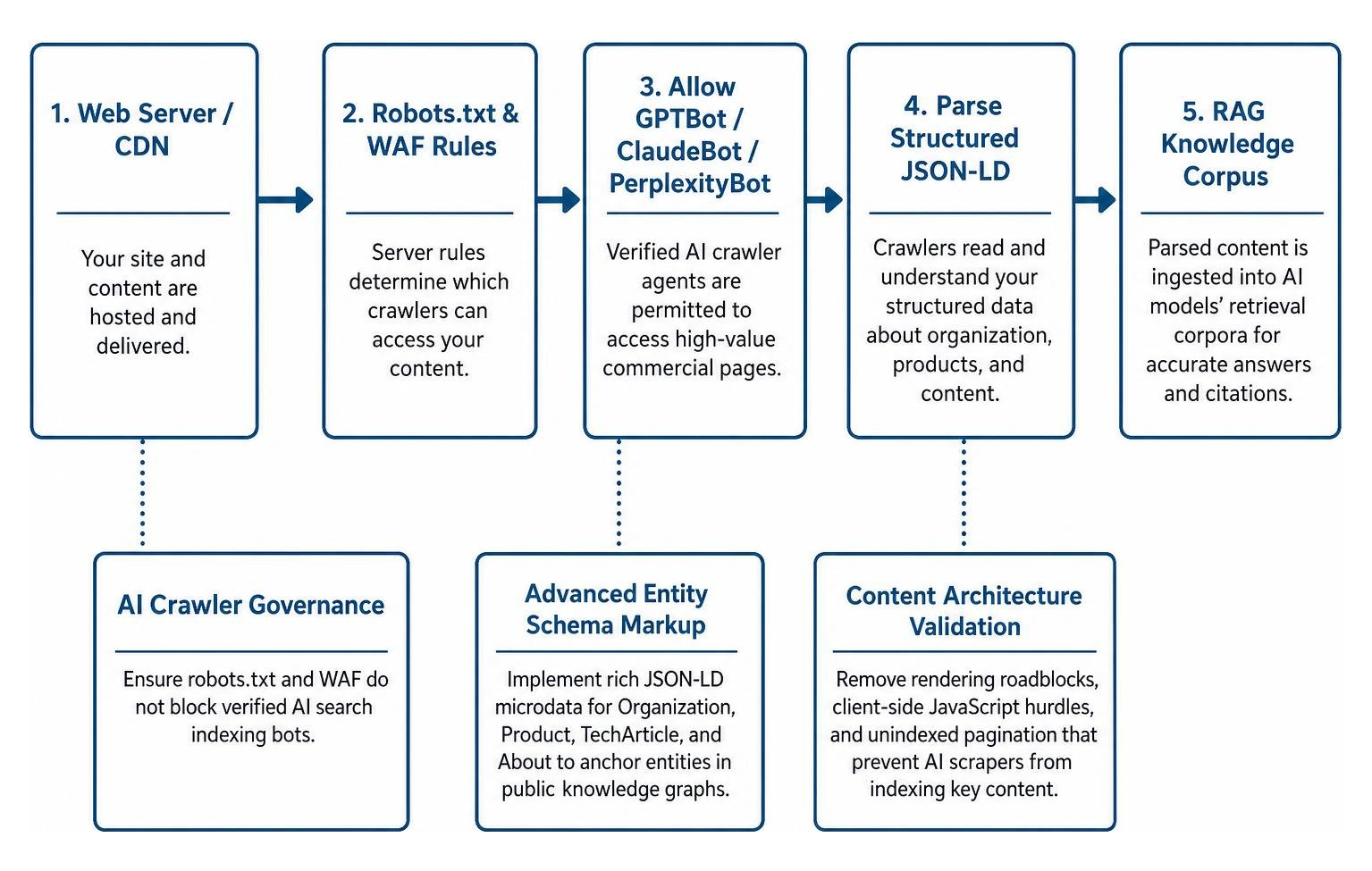
Key technical actions include:
- AI Crawler Governance: Ensuring
robots.txtfiles and Web Application Firewalls (WAF) do not inadvertently block verified AI search indexing bots. - Advanced Entity Schema Markup: Implementing rich JSON-LD microdata covering
Organization,Product,TechArticle, andAboutproperties to anchor brand entities within public knowledge graphs. - Content Architecture Validation: Removing rendering roadblocks, client-side JavaScript hurdles, or unindexed pagination that obstructs AI scrapers from indexing vital documentation.
Citation-First Content Engineering and Knowledge Graph Integration
Generative engines favor clear, fact-dense statements over generic promotional copy. To earn consistent citations, content must be engineered for informational extraction.
Applying proven strategies to write smarter LLM content, specialized services restructure core service and product pages. They introduce concise data tables, structured definitions, original proprietary statistics, and authoritative summary blocks.
Furthermore, because LLMs pull authority signals from broad digital ecosystems, these services coordinate external PR placements, digital brand mentions, and industry directory listings to build an undeniable web of entity consensus across the broader knowledge graph.
Measurable ROI and Business Outcomes of AI Search Optimization
Investing in generative visibility generates quantifiable, high-intent returns. Because prospects who query AI models are typically looking for tailored solutions, their purchase intent is exceptionally high.
Our AI search optimization guide shows that organizations optimizing for generative engines systematically outperform competitors relying solely on legacy search channels.

Documented outcomes from strategic generative optimization include:
- Higher Conversion Rates: Searchers utilizing generative platforms demonstrate a 4.4× higher conversion likelihood than standard web search visitors.
- Significant Traffic Growth: Targeted technical and content improvements have driven measurable lifts in generative referral visits, with brands seeing citation increases over 3.5× in less than six months.
- Robust Qualified Pipeline: Securing recommendations for high-intent B2B prompts directly populates CRMs with qualified accounts, accelerating enterprise deals.
- Defensive Market Positioning: Establishing early citation authority across ChatGPT, Perplexity, and Google AI Overviews prevents competitors from monopolizing AI-driven vendor lists.
Selecting Between In-House Tools and Managed AI Visibility Services
Many organizations start by purchasing standalone software subscriptions to monitor their brand mentions. While automated dashboards offer valuable data snapshots, tracking tools alone do not execute optimizations or solve complex technical issues.
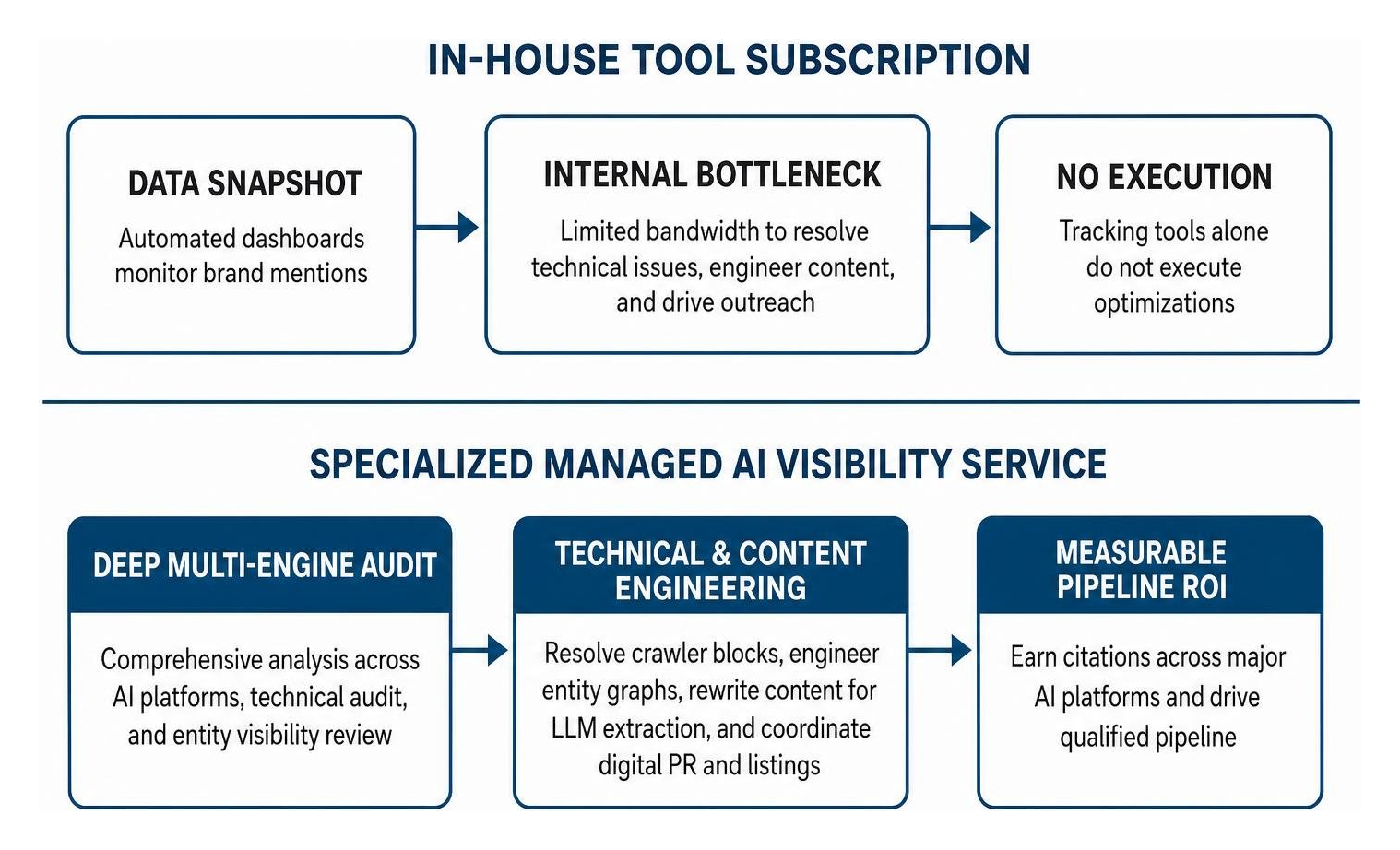
When reviewing our breakdown of the 10 best GEO marketing agencies, consider whether your internal team possesses the bandwidth to resolve crawler blocks, engineer entity graphs, rewrite content for LLM extraction, and conduct digital PR outreach.
A managed service bridges the gap between tracking numbers on a screen and executing the strategic work required to win citations across every major AI platform.
Frequently Asked Questions About AI Visibility Services
How quickly do AI visibility optimizations show measurable results?
Unlike traditional SEO, which can take six to twelve months to adjust domain metrics, baseline AI visibility shifts often appear much faster.
Once high-authority content is indexed, schema markup is parsed, and crawler access is restored, targeted updates can influence retrieval pipelines within 2 to 4 weeks. Full authority compounding across broader entity knowledge graphs typically solidifies over 3 to 6 months of continuous optimization.
How do AI visibility services track brand mentions across closed LLMs?
Professional services connect to official enterprise APIs provided by OpenAI, Anthropic, Google, and Perplexity. By running automated, programmatic prompt libraries that simulate real-world buyer searches across industries and regions, these platforms capture raw outputs without violating platform terms of service.
The responses are then parsed through natural language algorithms to evaluate exact brand positioning, citation links, source domains, and contextual sentiment.
Can AI search optimization replace traditional B2B SEO?
No. AI search optimization complements and enhances traditional organic search.
Generative models rely heavily on top-ranking indexed content, trusted domain authority, and authoritative backlinks to feed their retrieval systems. Implementing our dedicated generative engine optimization service ensures your brand maintains strong visibility in traditional SERPs while capturing valuable recommendations in conversational AI interfaces.
Conclusion: Maximizing Brand Authority in the Generative Search Era
Generative engines have changed how B2B buyers find, evaluate, and choose vendors. Relying exclusively on legacy search tactics leaves your brand vulnerable to competitors who are actively optimizing for conversational recommendations.
At BullsEye Internet Marketing, we focus on generating measurable calls, qualified leads, and closing enterprise sales. We eliminate client risk by offering no long-term contracts and providing strict market exclusivity—working with only one client per industry per geographic market. Whether your target audience is based locally in South Florida or across national enterprise territories, our team builds the technical foundations and authority signals your brand needs to dominate AI answer engines.
Ensure your company becomes the top-recommended choice across ChatGPT, Claude, Perplexity, and Google AI Overviews. Explore our comprehensive AI Visibility Optimization solutions today to secure your competitive advantage in generative search.
