
How Web Design and Digital Marketing Work Together to Drive Revenue
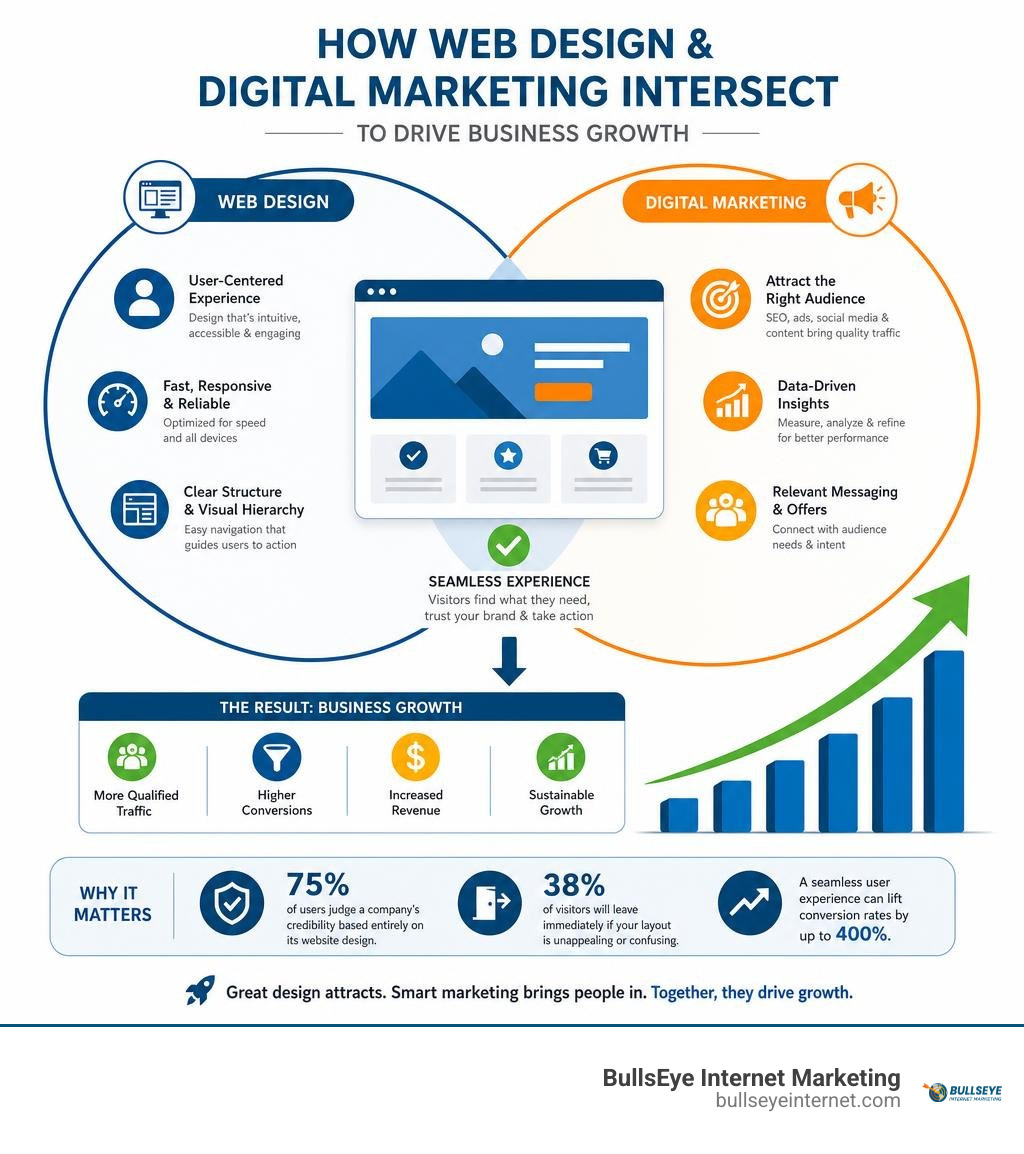
Integrating web design and digital marketing means aligning your visual layouts, site architecture, and user experience (UX) directly with measurable business goals. Marketing attracts qualified traffic, while thoughtful design guides those visitors smoothly toward a purchase or phone call.
To make design and marketing work as a single growth engine:
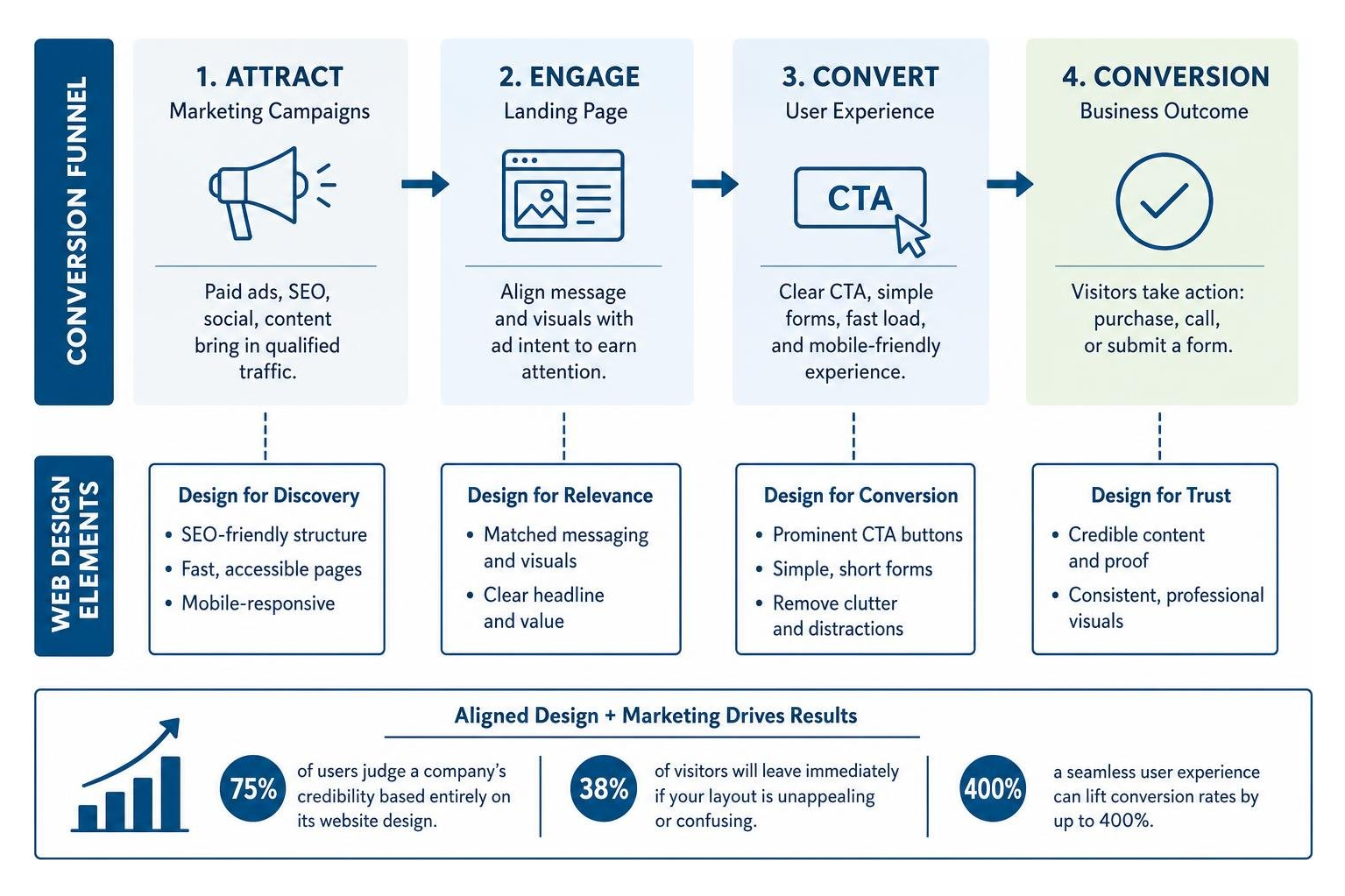
- Align landing pages with ad intent: Match your messaging, headlines, and visual style between paid ads and page layouts.
- Optimize for frictionless conversion: Remove visual clutter, speed up load times, and use clear call-to-action (CTA) buttons.
- Design for search and usability: Structure pages with clear headings and mobile responsiveness so both users and search engines can navigate easily.
Traffic without conversion is just an expensive vanity metric. Research shows that 75% of users judge a company’s credibility based entirely on its website design, and 38% of visitors will leave immediately if your layout is unappealing or confusing. However, when intuitive visual design supports your marketing strategy, a seamless user experience can lift conversion rates by up to 400%.
I’m Ronnie Katz, founder and Principal CEO of BullsEye Internet Marketing, where I’ve spent over 20 years helping businesses generate measurable leads and sales through proven web design and digital marketing strategies. Let’s look at how you can bridge the gap between creative design and data-driven marketing to maximize your return on investment.
Similar topics to web design and digital marketing:
Unifying Web Design and Digital Marketing for Maximum Growth
Marketing brings prospective buyers through your virtual front door. Web design determines whether they stay, browse, and buy—or hit the back button in frustration. When these two disciplines operate in silos, marketing dollars get wasted on traffic that never converts. When unified, every color choice, headline placement, and navigation link serves a clear commercial purpose.
Conversion optimization sits squarely at the crossroads of aesthetics and analytics. Understanding how a web design company can improve your user experience and conversion rates allows you to map every step of the customer journey with precision. By prioritizing clean layouts, intuitive navigation, and prominent calls to action, your website establishes immediate brand authority and turns casual visitors into qualified inbound leads.
The Impact of UX Design on Paid and Organic Traffic
User experience (UX) directly impacts how paid ad platforms and search engine algorithms evaluate your website. High bounce rates signal to Google that your landing page does not satisfy user intent, which can depress organic search rankings and increase paid cost-per-click (PPC) rates.
Recognizing the role of professional web design in SEO and online visibility ensures that critical technical factors—such as Core Web Vitals, mobile responsiveness, and clean site architecture—work in harmony with your promotional campaigns. When users enjoy fast page speeds and frictionless navigation, their dwell time increases, sending strong engagement signals to search engines.
Bridging Graphic Design and Digital Marketer Roles in Web Design and Digital Marketing
While graphic designers master visual storytelling, color theory, and composition, digital marketers specialize in user behavior, campaign analytics, and conversion funnels. Successful digital strategies require both skill sets to operate in tandem rather than in isolation.
| Skill / Focus Area | Graphic Designer | Digital Marketer | Combined Synergy |
|---|---|---|---|
| Primary Objective | Visual appeal, brand aesthetics, and creative layout | Traffic acquisition, lead generation, and ROI | Conversion-focused visual design that drives sales |
| Core Tools | Figma, Adobe Creative Cloud, typography software | Google Analytics, ad managers, SEO auditing tools | Data-backed design prototypes and iterative testing |
| Key Performance Metrics | Brand consistency, visual clarity, composition | CTR, CPA, conversion rates, customer lifetime value | Lower cost-per-acquisition via compelling visuals |
| 10-Year Career Outlook (BLS) | 2% projected growth | 8% projected growth | Integrated hybrid roles driving agency execution |
The Bureau of Labor Statistics projects an 8% increase in demand for marketing professionals from 2023 to 2033, compared to 2% growth for graphic designers. This difference underscores how purely aesthetic roles are evolving into hybrid disciplines where design must directly support performance marketing and measurable business revenue.
Designing High-Converting Digital Marketing Assets Across Channels

Creating high-performing marketing assets requires a consistent visual and tactical blueprint. From paid search ads to email sequences, your audience should experience an unbroken narrative as they move through your marketing funnel. Exploring a comprehensive guide to professional digital marketing services highlights how cohesive messaging across touchpoints eliminates confusion and boosts overall conversion velocity.
Anatomy of a High-Performing Landing Page
A landing page built for performance avoids unnecessary distractions and focuses user attention on a single desired action. High-converting pages incorporate specific structural elements:
- Hero Banner: A concise, benefit-driven headline paired with high-contrast imagery that immediately validates user intent.
- Persuasive Call-to-Action (CTA): Bold, accessible CTA buttons placed both above the fold and at logical decision points down the page.
- Trust Signals: Prominent placement of customer reviews, security badges, industry accreditations, and verifiable case studies.
- Streamlined Forms: Minimal form fields asking only for essential contact details to prevent drop-offs.
- Clear Visual Hierarchy: High contrast between text and background, paired with scannable bullet points and structured subheadings.
Omnichannel Brand Consistency in PPC, Social Media, and Email
With over 170 million people logging into social media during a typical week, your target market encounters your brand across multiple touchpoints before reaching a buying decision. If your social ads present one visual style and tone while your landing page presents another, users experience cognitive friction and leave.
Working with a dedicated digital marketing agency for small business ensures your color schemes, typography standards, and brand voice remain uniform across PPC ad creative, email marketing newsletters, and web properties. Consistent branding across channels fosters trust, enhances recall, and shortens the sales cycle.
Data-Driven Optimization and Modern Design Trends

Modern web design rejects guesswork in favor of behavioral data and performance analytics. Contemporary trends prioritize speed, accessibility, and purposeful interactions over excessive decorative elements. Implementing clean minimalism, subtle micro-animations, and high-contrast dark-mode options keeps visitors engaged without sacrificing page load speeds.
Modern Tools Powering Integrated Web Design and Digital Marketing
Developing agile, high-performing websites relies on modern UI/UX design tools that support rapid prototyping and campaign deployment. Utilizing Figma for wireframing and Framer or WordPress for implementation allows teams to launch campaign-specific landing pages quickly. Discovering professional WordPress design secrets the experts keep to themselves helps businesses build fast, flexible, and fully responsive websites that integrate seamlessly with CRM platforms and tracking software.
Rigorous A/B Testing and Conversion Rate Optimization (CRO)
A/B testing is the standard for turning good design into high-converting revenue drivers. By systematically testing different variables against a control version, you isolate the exact elements that motivate users to act:
- Headlines: Comparing emotional hooks versus direct, benefit-focused value propositions.
- Button Placement & Color: Testing high-contrast button styling and sticky CTA navigation.
- Form Layouts: Evaluating single-step forms against multi-step interactive lead captures.
- Imagery: Comparing authentic product or service photography with illustrative graphics.
Adopting transparent optimization workflows demonstrates why transparent digital marketing strategies lead to long-term success, giving your team clear data to justify design updates that improve ROI.
Common Web Design Pitfalls That Sabotage Marketing Campaigns
Even large marketing budgets can fail if the underlying website design creates barriers for users. Reviewing the ultimate guide to finding affordable web design solutions that actually work helps you steer clear of expensive technical missteps.
Avoid these critical design pitfalls:
- Slow Page Load Speeds: Heavy uncompressed images and bloated scripts drive bounce rates up and tank ad Quality Scores.
- Cluttered, Unfocused Layouts: Overwhelming visitors with competing offers, pop-ups, and auto-playing media causes decision paralysis.
- Inaccessible Typography and Poor Contrast: Low contrast ratios and tiny fonts alienate mobile visitors and violate standard accessibility guidelines.
- Broken Navigation and Mobile Friction: Hard-to-tap buttons, complex menus, and unresponsive layouts frustrate users on handheld devices.
Frequently Asked Questions About Web Design and Digital Marketing
How does web design directly impact digital marketing ROI?
Web design dictates conversion efficiency. Marketing campaigns drive paid and organic traffic to your site, but the UX, load speed, and visual clarity determine what percentage of visitors convert into paying customers. Superior design increases conversion velocity and lowers customer acquisition costs (CAC).
Why is cross-device responsiveness critical for modern marketing campaigns?
The majority of paid search and social media traffic originates from mobile devices. If a landing page is not fully optimized for smartphones and tablets, visitors will bounce immediately. Cross-device responsiveness ensures smooth performance, legibility, and effortless form submission on any screen size.
What is the biggest mistake businesses make when redesigning their website for marketing?
The most common mistake is prioritizing subjective visual aesthetics over user experience, technical SEO, and conversion tracking. Redesigns that alter page URLs without proper 301 redirects or strip away optimized copy frequently experience sharp drops in organic traffic and lead volume.
Conclusion
A high-performing online presence requires the seamless marriage of creative design and analytical marketing. When beautiful layouts are paired with conversion optimization, fast load speeds, and multi-channel consistency, your website becomes an active growth engine that delivers steady revenue.
At BullsEye Internet Marketing, we help businesses across Florida and throughout the United States scale their operations through Pay Per Lead, Google Business Profile Optimization, SEO, PPC, and conversion-focused web design. We operate with no long-term contracts and maintain a strict policy of working with only one client per industry per geographic area, providing you an exclusive competitive advantage in your market.
Ready to transform your online presence into a lead-generating powerhouse? Partner with our premier web design company today to build a website that looks exceptional and delivers measurable sales growth.
