
What Is AI Visibility and Why Does It Matter?
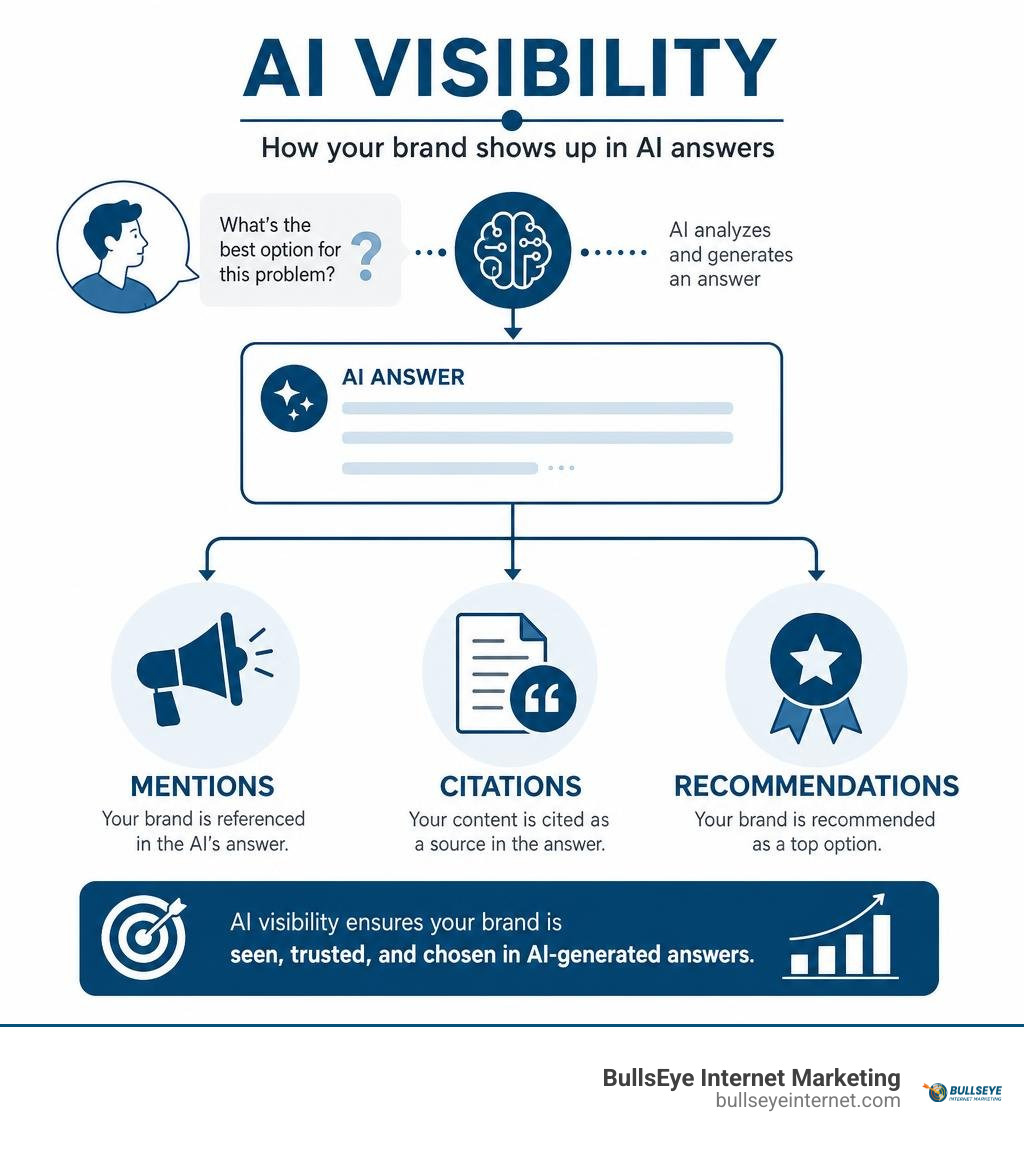
AI visibility is how often, how accurately, and how favorably your brand appears in AI-generated answers. This includes mentions, source citations, and recommendations in platforms such as ChatGPT, Google AI Overviews, Gemini, Perplexity, and Copilot.
In simple terms, when a potential customer asks an AI tool, “What is the best option for this problem?” AI visibility tells you whether your business is part of the answer – or whether the AI recommends a competitor instead.
This matters because digital discovery is moving beyond the familiar list of blue links. Google searches now end without a click 58% of the time, and AI Overviews can reduce organic click-through rates when they appear. Meanwhile, 47% of consumers have already used AI to help make a purchase decision.
Strong traditional SEO still helps. But ranking well does not guarantee an AI engine will name or cite you. AI systems also weigh clear information, brand consistency, trusted third-party coverage, reviews, topical expertise, and content they can retrieve and understand.
I am Ronnie Katz, founder and Principal CEO of BullsEye Internet Marketing, and I have spent more than 20 years helping businesses earn visibility, calls, and sales online. Understanding what is AI visibility is now a key part of building a marketing strategy that reaches customers before high acquisition costs and competitors take the lead.
What Is AI Visibility in Modern Search?
Digital search has fundamentally transformed. For decades, our digital discovery playbooks focused on winning one of the coveted “10 blue links” on a search engine results page (SERP). Today, generative search engines synthesize vast amounts of information across the web to construct unified, direct, conversational responses.
When users input complex natural language prompts, large language models (LLMs) do not simply provide a list of websites to browse; they act as an advisory layer, answering questions directly, synthesizing pros and cons, and curating brand recommendations. AI visibility measures your brand’s prominence and accuracy inside these synthesized responses.
| Traditional SEO Metric | AI Visibility Factor | Strategic Difference |
|---|---|---|
| SERP Rank (#1–#10) | Citation Presence & Mention Share | Moving from a linear list position to being synthesized inside an answer |
| Organic Click-Through Rate (CTR) | Conversational Recommendation Rate | Optimizing for direct brand selection within conversational outputs |
| Backlink Volume & Domain Authority | Entity Clarity & Corroboration | Shifting from raw link equity to semantic consensus across trusted sources |
| Keyword Search Volume | Prompt Coverage & Semantic Intent | Addressing complex multi-turn user queries instead of isolated target keywords |
| Impressions on SERP | Brand Sentiment & Grounded Citations | Tracking how favorably the engine portrays your business when referenced |
What Is AI Visibility Compared to Traditional Organic Rankings?
The difference between traditional rankings and AI-driven presence lies in SERP decoupling. In traditional SEO, your objective is to position a specific URL at the top of a static list. In generative environments, an AI engine might read your content, extract key facts, and present your solutions without ever displaying your raw metadata snippet.
Furthermore, being ranked number one on Google does not ensure you will appear in an AI summary. Recent industry data reveals that only 38% of citations in Google AI Overviews come from pages ranking within the traditional organic top 10. Generative engines evaluate content through semantic relevance and retrieval suitability rather than standard link weighting alone. To capture these changing touchpoints, exploring our AI Search Optimization Complete Guide provides the blueprint for adapting your assets to conversational engines.
The Core Components: Mentions, Grounded Citations, and AI Recommendations
To effectively analyze and optimize your presence, we evaluate three primary building blocks of AI visibility:
- Brand Mentions: The AI engine names your company or product explicitly when answering an industry-relevant prompt.
- Grounded Citations: The engine links directly to your digital properties as a verified source or supporting reference within its synthesized answer.
- AI Recommendations: The model endorses your product or service as a preferred solution for a specific user scenario.
Beyond simply appearing in the text, model memory, grounded retrieval, and brand sentiment dictate whether your business is framed as an industry leader or an afterthought.
Why AI Presence Dictates Brand Authority in 2026
The search ecosystem has reached an inflection point. With ChatGPT serving 910 million weekly active users, Google AI Overviews reaching 2 billion monthly users across more than 200 countries, and 48% of tracked queries triggering AI summaries, generative engines now serve as the front door for consumer inquiry.
When an AI engine summarizes market options, it shapes brand perception before a user ever visits your website. If your company is omitted from that summary, you lose influence at the earliest consideration phase. Establishing your footprint across these answer surfaces is critical, aligning with modern industry standards for AI era visibility measurement.
The Zero-Click Search Landscape and User Journey Compression
The traditional multi-stage marketing funnel—awareness, consideration, evaluation, and conversion—is consolidating rapidly. In modern generative search, this process is frequently compressed into a single, comprehensive interaction.

Because overall zero-click search rates hover around 58%, and reach up to 93% in dedicated AI search interfaces, users receive recommendations and evaluate options directly on the answer screen. When an AI Overview appears on standard Google results, organic click-through rates drop by an average of 61%. To remain relevant, your digital footprint must be positioned so answer engines extract and recommend your brand during this compressed pre-visit evaluation.
What Is AI Visibility Optimization and How Does It Drive Revenue?
While raw organic clicks on informational queries may decline, the quality of traffic emerging from AI platforms is notably higher. AI referrals generate 80% more revenue per visit compared to traditional web traffic. Why? Because users clicking through from an AI interface have already read an evaluation, compared alternatives, and decided to engage with a cited business.
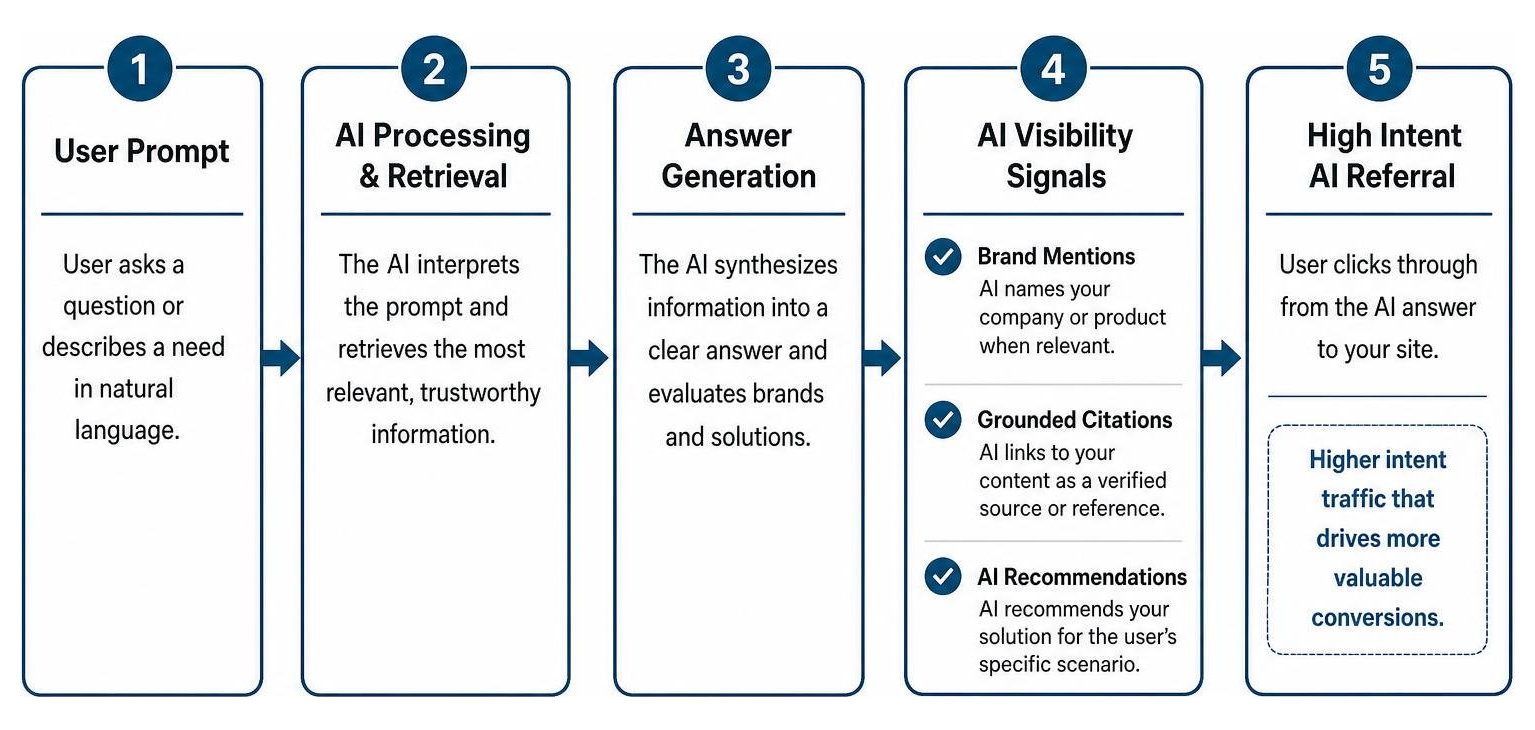
Optimizing your brand for generative search yields direct commercial returns. When cited in an AI Overview, brands experience a 35% increase in click-through rates compared to uncited competitors. Applying dedicated Generative Engine Optimization Services 101 allows businesses to turn passive brand mentions into active, highly qualified lead generation pipelines.
How Generative Engines Choose Sources and Build Citations
Generative systems do not make selections at random. They utilize a combination of learned training data and real-time information retrieval to construct accurate, high-utility answers. Understanding these mechanics is essential for mastering AI Search Ranking Factors across various engines.
Retrieval-Augmented Generation (RAG) and Crawler Access
Most modern conversational engines rely on Retrieval-Augmented Generation (RAG). Under RAG architecture, when a user asks a question, the platform executes real-time web searches to gather external reference documents, feeds those documents into its context window, and synthesizes a cited response.
For your business to be retrieved and cited:
- Crawler Access Must Be Unrestricted: Crawlers such as GPTBot, OAI-SearchBot, and PerplexityBot must be permitted in your
robots.txtfile. Interestingly, 85% of the top 1,000 news publishers block major AI crawlers, creating a massive opportunity for accessible commercial sites to fill the citation void. - Server-Side Rendering: Core information must be instantly readable in the clean HTML response, without relying on client-side JavaScript execution.
- Fast HTTP Delivery: AI crawlers prioritize low-latency, readily accessible web servers.
Following a vetted LLM SEO Best Practices Guide ensures your technical infrastructure is accessible to AI retrieval bots.
Structured Data, Entity Authority, and Third-Party Corroboration
AI models rely heavily on Knowledge Graphs and entity association. They do not just index keywords; they seek to understand what your organization is, what services you provide, and what level of authority you hold.
To establish verifiable entity authority, generative engines evaluate:
- Schema Markup: Utilizing structured JSON-LD data (such as
Organization,Product,FAQPage, andServiceschema) to explicitly define core attributes. - Third-Party Corroboration: Consistent citations across trusted industry directories, review platforms, and authoritative news outlets. Brands in the top 10% for media influence are recommended by LLMs 80% of the time.
- Digital PR and Semantic Consensus: Ensuring that your brand name and industry niche are consistently referenced together across diverse external websites.
Industry Variations Across SaaS, E-Commerce, and Healthcare
Generative engine behavior varies significantly depending on the industry and the nature of the query:
- B2B SaaS and Technology: AI engines heavily emphasize feature comparison matrices, user reviews, pricing transparency, and API documentation. SaaS buyers frequently ask for “best alternatives to [software],” making inclusion in third-party roundups essential.
- E-Commerce: AI Overviews pull directly from product feeds, structured
Productschema, inventory availability, and customer feedback across multiple platforms. - Healthcare and YMYL (Your Money, Your Life): Accuracy and source credibility are evaluated with extreme scrutiny. Medical and financial queries demand verifiable medical reviews, author credentials, peer-reviewed citations, and compliance with stringent information standards.
Key Metrics and Frameworks for Measuring AI Brand Presence
Measuring your performance in conversational search requires moving beyond simple keyword rank tracking. Because generative outputs are personalized and conversational, we utilize composite measurement frameworks to assess total market share.

Core Tracking Metrics: Share of Voice, Citation Rate, and Prompt Coverage
To maintain an objective view of your presence across AI platforms, tracking these four core metrics is vital:
- AI Share of Voice (SoV): The percentage of industry-relevant prompts in which your brand is named or recommended relative to your competitors.
- Citation Share & Rate: How frequently an AI engine includes clickable links back to your domain when discussing your sector or service category.
- Prompt Coverage: The breadth of natural language questions and buyer-intent prompts that trigger your brand across different models (ChatGPT, Gemini, Claude, Perplexity).
- Composite AI Visibility Score: A normalized index combining mention frequency, sentiment rating, citation prominence, and competitor benchmarking into a single trackable KPI.
For a structured audit of your existing footprint, applying our LLM SEO Audit Best Practices establishes an actionable performance baseline.
Overcoming Non-Deterministic Outputs and Sampling Bias
A key challenge when evaluating generative search is that LLM outputs are non-deterministic. If you run the exact same prompt five times, you may receive five slightly different answers with varying brand citations.
To address this variance:
- Run Multi-Run Sampling: Measure brand mentions across 10 to 20 automated samples of the same prompt set over multiple weeks to determine a statistically sound mention rate.
- Track Across Environments: Evaluate queries via both consumer web interfaces and direct APIs, accounting for differences in search grounding.
- Focus on Aggregate Trends: Avoid overreacting to a single isolated query output; instead, track monthly directional shifts in Share of Voice.
Strategic Playbook to Maximize Your Brand’s Generative Presence
Building high AI visibility requires a coordinated strategy combining technical accessibility, structured content architecture, and authoritative off-site signals.
Structuring Content for Machine Extraction and High Fact Density
Generative models prefer clear, concise content that can be extracted cleanly into an answer snippet. We optimize content for machine extraction using these proven formats:
- Answer-First (BLUF) Structure: State the core answer, summary, or definition within the first 40–60 words of every section before elaborating.
- High Fact Density: Include verified data points, exact figures, and proprietary statistics every 150–200 words. Factual depth directly increases citeability.
- Structured HTML Tables: Use clean HTML tables to compare features, pricing, or service tiers, making it easy for engines to parse complex data sets.
- Question-Based H2s and H3s: Structure subheadings to mirror natural-language user queries, supported by relevant structured data.
Our guide on Answer Engine Optimization AEO GEO LLM SEO covers these on-page formatting techniques in comprehensive detail.
Building Citation Scarcity and Cross-Platform Grounding
As traditional publishers increasingly block generative crawlers to protect their content, businesses that remain crawlable gain an outsized citation advantage.
- Ensure Open Crawler Directives: Confirm your web infrastructure does not accidentally block
OAI-SearchBot,PerplexityBot, orGoogle-Extended. - Diversify Off-Site Mentions: Build digital PR assets, earn reviews on respected industry platforms, and secure mentions on niche-specific sites that AI engines use for grounded retrieval.
- Maintain Cross-Web Consistency: Ensure your core entity details (company name, service offerings, physical locations, and leadership profiles) remain identical across every digital channel.
For an end-to-end implementation roadmap, explore A Practical Guide to LLM SEO Strategies.
Frequently Asked Questions About AI Search Presence
Is AI visibility the same as Generative Engine Optimization (GEO)?
While the two terms are closely related, Generative Engine Optimization (GEO) refers to the strategic process and tactics used to optimize your digital assets for conversational engines, whereas AI visibility is the measurable outcome—the degree to which your brand is actually cited, mentioned, and recommended by those engines. You practice GEO to improve your AI visibility. To learn more about executing these strategies, review our guide on How to GEO.
How does AI visibility affect consumer purchase decisions?
AI recommendations carry significant social proof because users perceive conversational answers as objective, expert synthesis rather than paid advertisements. Research indicates that 47% of consumers have relied on AI recommendations to guide a purchase decision. When an engine highlights your business as a top provider, it instills immediate buyer confidence and shortens the evaluation cycle.
Can a website rank #1 on Google and remain invisible in AI Overviews?
Yes. Search rankings and AI citations have decoupled significantly. Data shows that less than 40% of links featured inside Google AI Overviews originate from the top 10 organic SERP positions. AI engines prioritize extractable, fact-dense content that directly answers the context of a query, allowing well-structured pages from authoritative sources to outshine older, high-ranking websites that lack semantic clarity.
Conclusion
As traditional search continues to evolve into synthesized, conversational experiences, businesses can no longer rely solely on legacy SEO rankings. Securing your presence within AI-generated recommendations is essential to driving high-intent inquiries and maintaining market leadership.
At BullsEye Internet Marketing, we help businesses across the United States—including companies throughout Florida in South Florida, Broward County, Miami-Dade County, and Palm Beach County—capture high-converting leads through advanced search strategies, Pay Per Lead programs, and search optimization. We stand behind our work by operating with no long-term contracts and providing true market exclusivity by partnering with only one client per industry per geographic area.
Ready to ensure your business dominates both traditional and generative search? Partner with our team for comprehensive AI Visibility Optimization and secure your competitive advantage today.
