
Why Small Business Owners Should Pay Attention to Bing Ads
Bing Ads for small business offers a powerful opportunity that many business owners overlook. Here’s what you need to know:
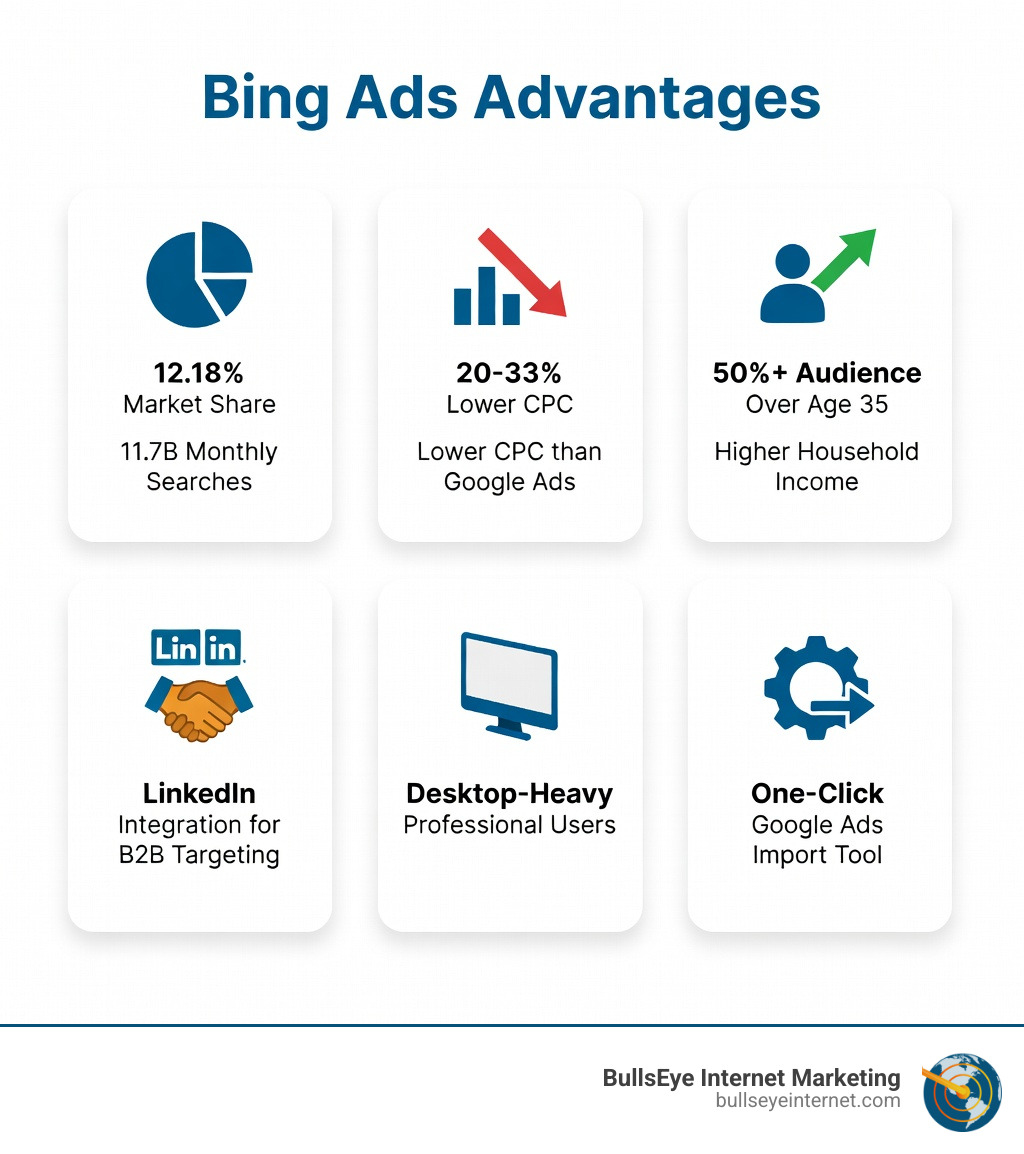
- Lower costs: Pay 20-33% less per click compared to Google Ads
- Quality audience: Reach older, higher-income users (50%+ are 35+)
- Less competition: Easier to rank for competitive keywords
- Professional reach: Strong presence among B2B decision-makers
- Easy setup: Import Google Ads campaigns in minutes
- LinkedIn targeting: Target by job title, industry, and company
When most people think of online advertising, Google Ads dominates the conversation. But here’s the reality: you’re missing out on 11.7 billion monthly searches if you ignore Microsoft Advertising (formerly Bing Ads).
The numbers tell a compelling story. While Google commands about 75% of search market share, Bing still captures over 12% of searches. More importantly, those searches come from users who are older, more affluent, and often making purchasing decisions from their work computers. If you’re frustrated with high acquisition costs and poor conversion rates from your current marketing, this could be your answer.
The platform is particularly valuable for small businesses operating in competitive industries. With fewer advertisers bidding on the same keywords, you can stretch your budget further and actually compete against larger competitors. Many businesses report better ROI on Bing simply because they can afford to stay in the game longer.
I’m Ronnie Katz, and over the past 18+ years running BullsEye Internet Marketing, I’ve helped countless small businesses reduce their customer acquisition costs through strategic use of Bing Ads for small business campaigns. The platform consistently delivers results for businesses willing to test beyond Google’s crowded marketplace.
Related content about Bing Ads for small business:
What is Bing Ads for Small Business?
When we talk about Bing Ads for small business, we are actually talking about the Microsoft Advertising Network. While “Bing” is the search engine most people recognize, your ads aren’t just showing up on one site. They appear across a massive ecosystem that includes Bing, Yahoo, and AOL. Yes, you read that right—people still use AOL and Yahoo!
For a small business owner in Miami or West Palm Beach, this means your reach extends to anyone using Microsoft Edge (the default browser on millions of Windows computers), plus partner sites like DuckDuckGo and Ecosia. Because Bing is the default search engine for Microsoft devices, it captures a massive amount of “built-in” traffic from professionals who search directly from their taskbars or within the Edge browser.
Working with a Bing Ads Specialist can help you steer this network. Unlike other platforms that feel like a “winner-takes-all” environment, Microsoft Advertising is designed to be accessible. It provides a way for local service providers—from HVAC companies in Fort Lauderdale to law firms in Boca Raton—to get their message in front of a high-intent audience without the cutthroat bidding wars common elsewhere.
Comparing Bing Ads for Small Business to Other Platforms
It is easy to look at search engine market share and think Google is the only game in town. Google holds roughly 75% of the market, while Bing sits at about 12.18%. However, that “small” slice represents 11.7 billion monthly searches. For a small business, 11.7 billion is more than enough opportunity to find your next hundred customers.
The primary difference lies in the competition. Because most marketers flock to Google, the “bidding floor” is much higher there. On Bing, you might find only one-half or one-third as many competitors bidding on your keywords. This lack of “crowding” often leads to better ad placements. Instead of being buried at the bottom of page one, your ad has a much higher chance of sitting in those coveted top spots.
| Feature | Google Ads | Microsoft (Bing) Ads |
|---|---|---|
| Market Share | ~75% | ~12.18% |
| Avg. CPC | Higher ($2.00 – $20.00+) | 33.5% – 42% Lower |
| Competition | Extremely High | Moderate to Low |
| Demographics | Broad / All Ages | Skews 35+, Affluent |
| B2B Targeting | Limited | LinkedIn Integration |
| Device Control | Limited | Granular (Desktop/Mobile) |
As you can see, Bing Ads for small business isn’t about replacing Google; it’s about supplementing it. It’s about finding the “low-hanging fruit” that your competitors are too busy to pick.
Primary Benefits of Microsoft Advertising
The most immediate benefit we see for our clients is the impact on the bottom line. Because fewer advertisers are bidding for the same keywords, the cost per click (CPC) is often 20–30% cheaper—and in some industries, it can be up to 42% less.
Imagine you have a monthly budget of $1,000. On Google, that might get you 100 clicks at $10 each. On Bing, those same clicks might cost $6.50, giving you 153 clicks for the same $1,000. That is 53 extra chances to make a sale every single month. For a small business in Broward County or Palm Beach County, that extra traffic can be the difference between a slow month and a record-breaking one.
When you partner with a Bing Advertising Agency, you can leverage these lower costs to achieve a much higher Return on Investment (ROI). We often find that while the volume of leads is lower on Bing, the quality of those leads is significantly higher. There is less “click fraud” or bot traffic, meaning more of your budget goes toward reaching real human beings who are ready to buy.
Reaching the Right Audience with Bing Ads for Small Business
Who exactly is using Bing? The demographic profile is a goldmine for many small businesses. Research shows that the Bing audience is:
- Older: Over 50% of users are 35 years or older.
- Affluent: Users tend to have higher household incomes compared to the internet average.
- Professional: A huge portion of Bing traffic comes from corporate environments where Microsoft products are the standard.
This makes Bing Ads for small business particularly effective for B2B marketers. If you are selling software, consulting services, or high-end legal services, you want to reach the person sitting at their desk in an office. That person is likely using a Windows computer with Bing as their default search engine.
Furthermore, Bing users are often further along in the buying cycle. They aren’t just “browsing”; they are often decision-makers in their households or companies. By targeting this mature, affluent audience, you are positioning your business in front of people who actually have the disposable income to afford your products or services.
Advanced Targeting and Unique Features
One of the most powerful tools in the Microsoft Advertising arsenal is its unique targeting capabilities. While Google has moved toward more “automated” (and often less transparent) targeting, Bing still offers granular control that small businesses love.
The “crown jewel” of these features is the LinkedIn Profile Targeting. Because Microsoft owns LinkedIn, they allow you to layer professional data on top of your search ads. You can target users based on:
- Job Title: Reach only “CEOs” or “Property Managers.”
- Industry: Target “Healthcare,” “Finance,” or “Construction.”
- Company: Show ads specifically to employees of certain organizations.
This is a game-changer for a Bing Ads Expert looking to generate high-quality leads. If you’re a commercial landscaper in Jupiter, FL, you don’t want to show ads to everyone; you want to show them to Facility Managers. Bing Ads makes that possible.
Additionally, Microsoft offers superior device-level bidding. Unlike Google, which often lumps desktop and tablet traffic together, Bing allows you to adjust bids specifically for desktops, smartphones, and tablets. Since Bing has a stronghold on desktop users—especially professionals working 9-to-5—you can choose to put 100% of your budget toward desktop users if that’s where your conversions happen.
Leveraging E-commerce and Lead Generation
For e-commerce sellers, Microsoft Shopping Campaigns are a must. They mirror the format of Google Shopping, displaying product images, pricing, and ratings directly in the search results. Because there is less competition, your “Cost Per Acquisition” (CPA) is often much lower, allowing you to maintain healthy profit margins even on lower-priced items.
For local lead generation, the platform offers robust local ad formats. You can target by:
- Postcode or City: Target specific neighborhoods like Coral Gables or Weston.
- Radius Targeting: Set a 10-mile radius around your shop in Miami Gardens.
- Location Extensions: Show your business address and phone number to drive foot traffic.
We also see massive opportunities in voice search and AI integration. Bing is the engine behind Microsoft’s AI tools like Copilot and the search function in Windows. As more people use voice assistants or AI chat to find local services (“Hey Copilot, find a plumber near me”), having an active Bing Ads presence ensures your business is the one being recommended.
How to Set Up and Manage Your Campaigns
One of the biggest problems for small business owners is the fear that a new platform will take too much time to learn. Microsoft has solved this with their one-click tool for importing Google Ads.
If you already have a Google Ads account, you can literally sync your entire campaign structure—keywords, ad copy, and settings—into Bing in minutes. You don’t have to start from scratch. You can even set it to “auto-sync” so any changes you make in Google are automatically reflected in your Bing account.
When setting up, we recommend focusing on keyword themes. Instead of bidding on thousands of broad terms, choose themes that represent high search intent. For example, a bakery in Boynton Beach shouldn’t just bid on “cookies”; they should bid on “buy cookies online” or “cookie delivery near me.”
Effective management is key to success. Our Microsoft Advertising Management Guide emphasizes starting with a modest budget. Because the CPC is lower, you don’t need thousands of dollars to see if it works. Start with $10-$20 a day, monitor which keywords are driving calls, and scale from there.
Overcoming Common Challenges
No platform is perfect, and Bing Ads for small business comes with its own set of challenges. The most common issue is low impressions. Because the search volume is lower than Google’s, you might find that your ads aren’t showing as often as you’d like. The fix? Broaden your keyword match types slightly or expand your geographic targeting.
Another challenge is CTR (Click-Through Rate) optimization. Since the Bing audience is more mature, they tend to respond better to clear, professional, and value-driven ad copy rather than “clickbait” headlines. We recommend:
- A/B Testing: Run two versions of an ad to see which one gets more clicks.
- Ad Extensions: Use sitelinks, call extensions, and structured snippets to take up more space on the screen.
- Regular Monitoring: Check your “Search Terms Report” weekly to exclude irrelevant searches that are wasting your money.
Frequently Asked Questions about Bing Ads
Is Bing Ads cheaper than other platforms?
Yes, absolutely. On average, Microsoft Ads clicks cost between 33.5% and 42% less than Google Ads. Because there are fewer advertisers competing for the same space, the “market price” for a click is lower. This is especially true in high-competition industries like legal, insurance, and home services.
Can I import my existing campaigns?
Yes. Microsoft offers a seamless import tool that allows you to pull your campaigns directly from Google Ads. It retains your ad groups, keywords, and even your tracking parameters. It is the fastest way to get started without having to reinvent the wheel.
Is Bing Ads good for B2B companies?
It is arguably the best search platform for B2B. Because of the LinkedIn integration and the fact that most corporate offices use Windows/Edge by default, you are reaching professionals while they are in “work mode.” Targeting by job title and company allows for a level of precision that standard search ads simply can’t match.
Diversify with Bing Ads to Reduce Risk – BullsEye Internet Marketing
In digital marketing, diversification is the best way to reduce risk. Relying solely on one platform leaves your business vulnerable to sudden price hikes or algorithm changes. Bing Ads for small business provides a stable, cost-effective, and high-quality alternative (or complement) to your existing efforts.
At BullsEye Internet Marketing, we specialize in helping small businesses across the United States—and specifically throughout Florida, from Miami to West Palm Beach—open up the potential of Microsoft Advertising. Our “no long-term contracts” policy and our commitment to working with only one client per industry in each geographic area give you a distinct competitive advantage.
If you are tired of overpaying for clicks and want to reach an affluent, professional audience, it is time to give Bing a second look. Whether you’re in Coconut Creek, Hollywood, or downtown Miami, the customers are there—they’re just waiting for you to show up. Reach out to us today to see how we can boost your lead generation!
