
Why OpenAI ChatGPT Ads Matter for Digital Advertisers
OpenAI ChatGPT ads give businesses a way to reach people while they are actively researching, comparing, and deciding. Rather than targeting a loose keyword search, advertisers can match offers to conversational intent – such as planning a trip, evaluating software, or shopping for a product. Campaigns can use contextual relevance, geographic targeting, custom audiences, product feeds, and CPC or conversion-focused bidding.
That makes conversational search a potentially valuable new channel for businesses facing high acquisition costs. ChatGPT now has more than 1 billion weekly active users, and its ad platform has expanded to more than 40 countries. Ads are clearly marked as sponsored, kept separate from ChatGPT’s answers, and designed not to affect what the model tells users.
For advertisers, the opportunity is simple: show up when a customer is working through a real problem, not just scrolling past another interruption. The sections ahead break down the formats, targeting, measurement, privacy rules, and practical limits that matter before you invest.
I’m Ronnie Katz, founder and Principal CEO of BullsEye Internet Marketing, with more than 20 years of experience helping businesses improve visibility, leads, and conversion results. As openai chatgpt ads become a new performance channel, I focus on testing emerging opportunities with transparent measurement and a clear connection to calls, sales, and ROI.
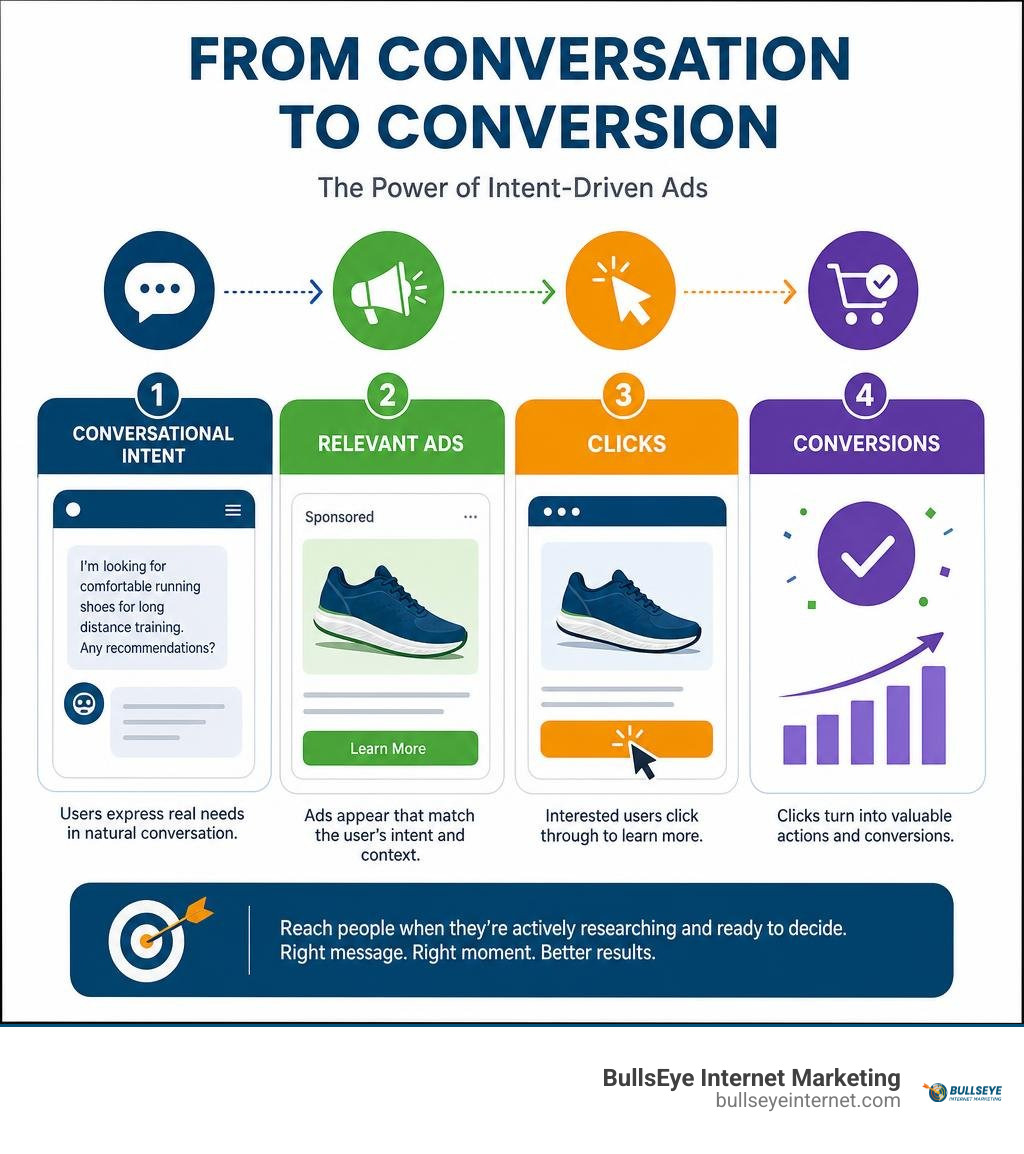
The Evolution and Global Expansion of OpenAI ChatGPT Ads
The rise of conversational search advertising represents one of the fastest platform rollouts in modern digital marketing. When OpenAI first began testing sponsored placements, the core objective was simple: sustainably fund free access for hundreds of millions of daily users without compromising answer quality.
That initial pilot quickly evolved into a robust ecosystem. Reaching a landmark $1 billion annualized revenue run rate in under 200 days from rollout, the platform proved that natural dialogue represents a highly engaging decision-making surface. As highlighted in A milestone in expanding access to AI, OpenAI transitioned from an early invite-only trial to a self-serve platform accessible via the OpenAI Ads Manager.
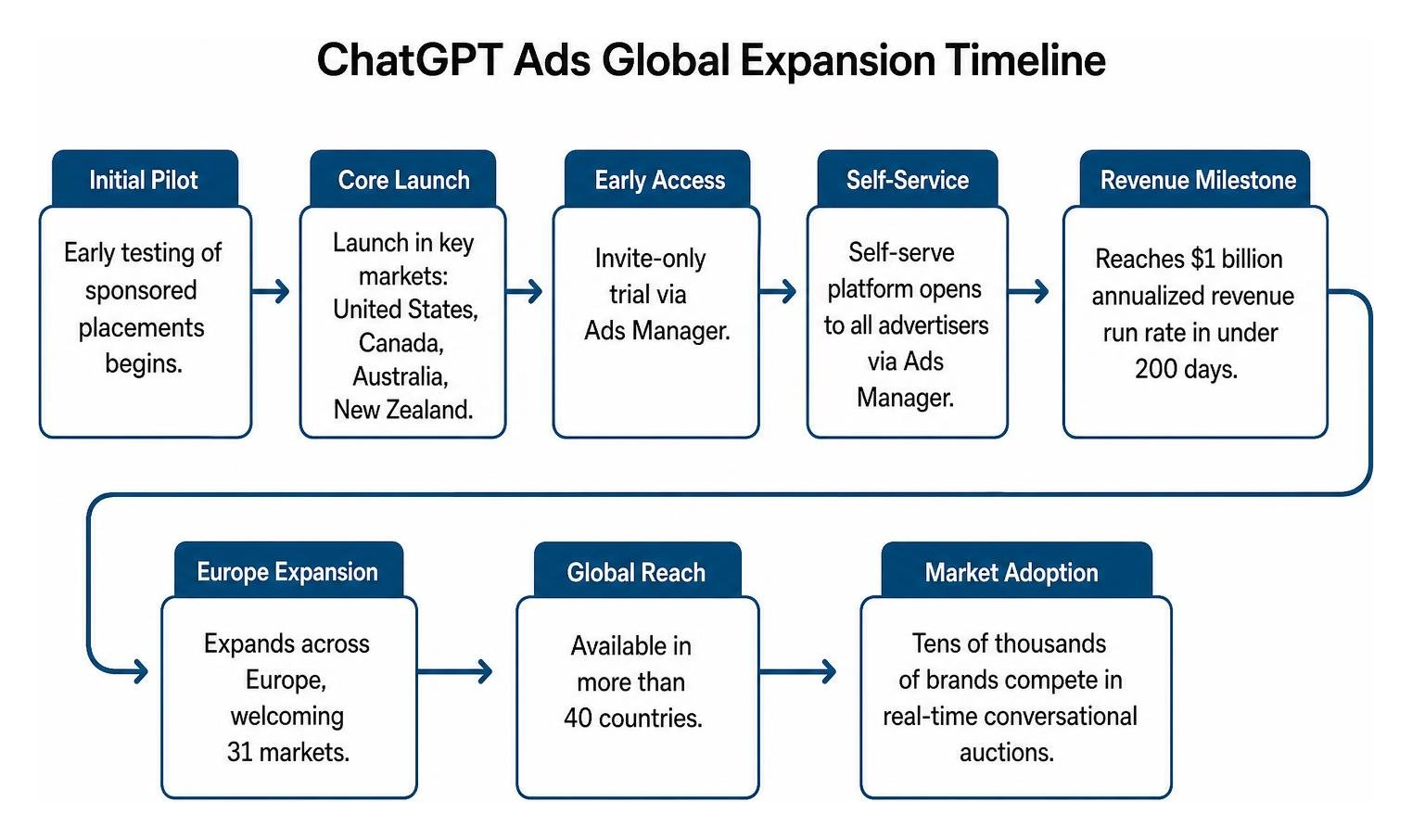
Following initial deployments across core launch regions including the United States, Canada, Australia, and New Zealand, OpenAI rapidly brought conversational ads to over 40 countries. A major leap forward arrived when ChatGPT Ads expands across Europe, welcoming 31 European markets into the network. Tens of thousands of brands now compete in real-time conversational auctions, transforming this channel from an experimental sandbox into a fundamental pillar of modern omnichannel strategy.
5 Pillars Defining Conversational Search for Digital Advertisers
Traditional search engines rely heavily on fragmented keyword fragments. A user types “best CRM software small business” and parses through ten blue links filled with generic landing pages. Conversational search shifts this dynamic entirely.
In a conversational environment, prospective customers provide rich context, articulate multi-layered constraints, and actively evaluate solutions in real time. Marketers who master this space are discovering a completely new way to capture high-intent demand. To understand how conversational AI fits into modern search marketing, explore our AI Search Optimization Guide 2026.
Below are the five core pillars that define how conversational ads work and why they represent a powerful frontier for performance marketing.
1. Intent-Based Contextual Ad Delivery
The foundation of conversational ad serving is deep contextual intent recognition. Instead of matching standalone search strings, the platform evaluates the live dialogue context, recent conversational prompts, and the underlying problem the user wants to solve.
- Dialogue Depth: If a user is discussing kitchen remodeling budgets and contractor timelines, the system recognizes a high-intent commercial moment.
- Organic Relevance Signals: Sponsored suggestions trigger naturally when the conversational flow indicates an active evaluation phase, ensuring recommendations feel helpful rather than disruptive.
- Zero Answer Bias: The organic AI response is generated completely independently of the advertising system. The ad simply appears adjacent to or below the completed response when commercial intent is detected.
This approach creates an environment where brand messaging aligns directly with real-time decision-making, offering solutions at the precise second a user seeks them.
2. Core Targeting Mechanics in OpenAI ChatGPT Ads
Targeting in conversational environments combines traditional advertising controls with advanced conversational understanding. Advertisers can ensure their campaigns reach the exact audiences most likely to convert while maintaining complete control over spend and placement criteria.
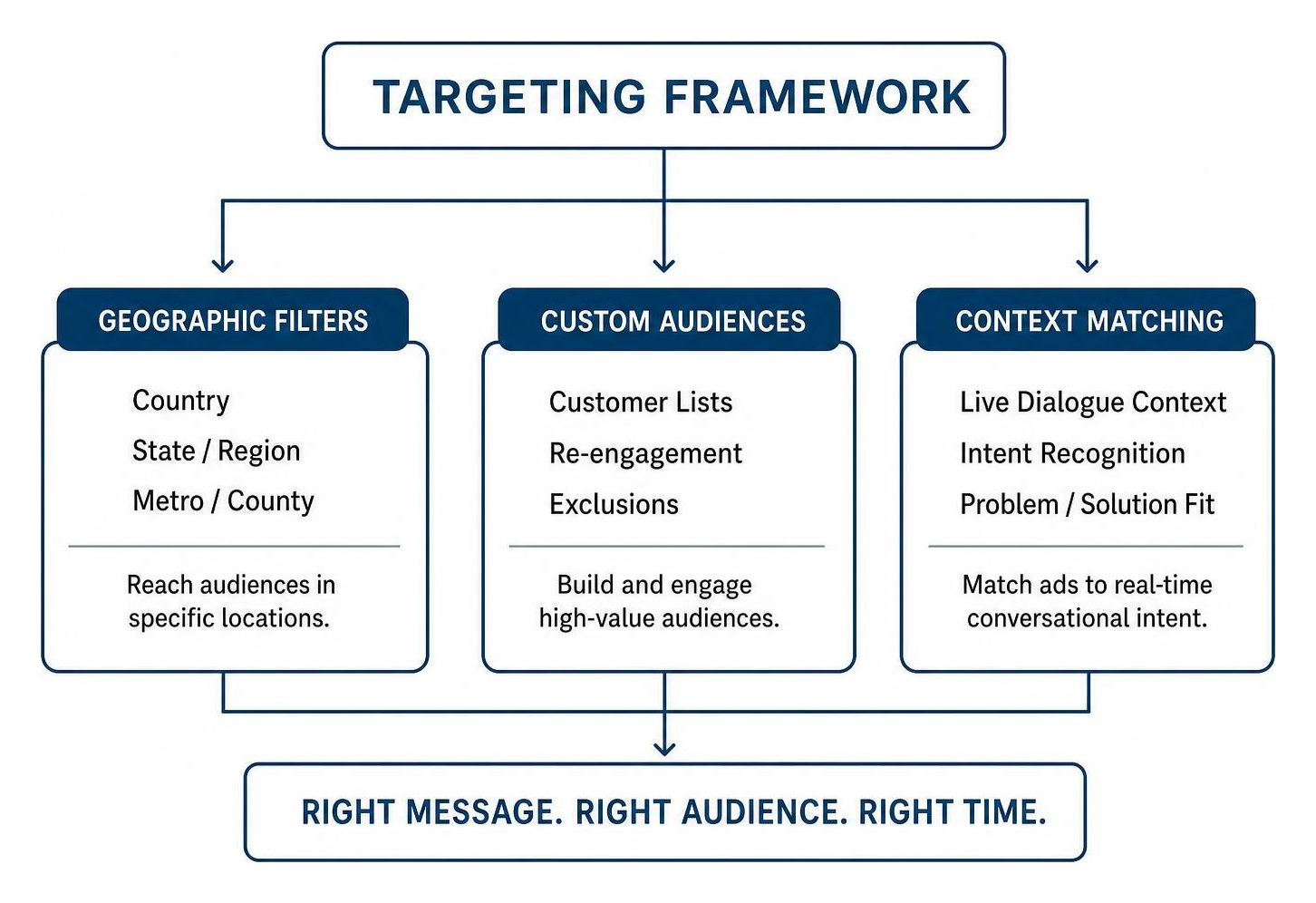
Key targeting layers available within the advertising interface include:
- Geographic Targeting: Precise geo-targeting allows local service providers and regional brands to reach prospects in specific countries, states, counties, and metro markets.
- Custom Audiences: Marketers can securely onboard customer lists to build re-engagement pools, loyalty campaigns, or exclusion lists.
- Dynamic Product Feeds: E-commerce stores can connect structured product catalogs, allowing the system to display relevant SKU recommendations based on the user’s conversational requests.
- Conversation Topic Alignment: Campaigns can be mapped to broad lifestyle, professional, travel, software, and consumer categories while filtering out off-topic discussions.
- Negative Context Exclusions: Brands can specify sensitive keywords or negative topics to prevent placements in inappropriate scenarios.
By layering precise geographic parameters with rich intent matching, businesses can generate high-quality phone calls, consultation bookings, and e-commerce orders without wasted ad spend.
3. Transparent Placement and Answer Independence
Trust is the single most valuable currency in conversational AI. If users feel that recommendations are secretly sponsored answers, consumer confidence evaporates. OpenAI addresses this by maintaining a strict operational boundary between organic model responses and sponsored units.
As outlined in the official guidance for Ads in ChatGPT, sponsored content adheres to clear operational principles:
- Clear Visual Labeling: All advertisements carry prominent “Sponsored” indicators, cleanly separated from the organic conversational output.
- Independent Algorithmic Generation: The underlying large language model never alters its factual synthesis, logic, or citations to favor a paying advertiser.
- No Pay-to-Play organic placement: Advertisers cannot pay to alter ChatGPT’s reasoning, ensuring that AI-generated summaries remain unbiased.
- User Trust Metrics: Ongoing pilot evaluations demonstrate stable user trust scores and remarkably low ad dismissal rates due to transparent visual boundaries.
This separation ensures that users continue to rely on the platform as an authentic advisor while viewing sponsored placements as useful, optional next steps.
4. Flexible Bidding Models for Performance Marketers
To accommodate diverse business goals, the platform has expanded its purchasing mechanics beyond early impression-based models. Through recent updates detailed in New ways to buy ChatGPT ads, advertisers can leverage a variety of bidding methods tailored to measurable business outcomes:
- Cost-Per-Thousand Impressions (CPM): Ideal for brand discovery, product launches, and top-of-funnel reach among high-intent audiences.
- Cost-Per-Click (CPC) Bidding: Perfect for direct-response campaigns, allowing marketers to pay only when an interested user takes proactive action by clicking through to a landing page.
- Outcome-Optimized Bidding: Uses conversion data to dynamically adjust bids for users most likely to fill out a lead form, schedule a consultation, or complete an online transaction.
This flexibility allows small businesses and global enterprises alike to maintain strict cost-per-acquisition (CPA) targets and maximize budget efficiency across competitive verticals.
5. Measuring ROI and Conversion Tracking with OpenAI ChatGPT Ads
Measuring the path from conversational engagement to closed revenue is essential for performance marketing. Advertisers have access to robust, privacy-safe analytics tools designed to track performance across the entire sales cycle.

Key tracking and integration features include:
- OpenAI Pixel: A lightweight tracking snippet placed on your website to measure site visits, key page views, add-to-cart actions, and form completions.
- Conversions API (CAPI): Server-to-server data pipelines that send authenticated purchase and lead events directly from your CRM or e-commerce backend, mitigating browser-level signal loss.
- Detailed Attribution Reporting: Comprehensive reporting on impressions, clicks, click-through rates (CTR), conversion rates, and effective cost-per-lead (CPL).
Early campaign data demonstrates substantial commercial performance. Across multi-week campaign flights, e-commerce brands have documented a 3x return on ad spend (ROAS), while technology and software partners have reported that over 80% of ad-driven traffic represents entirely new customers.
For businesses looking to build a unified strategy that connects paid conversational ads with organic generative visibility, review The Ultimate Guide to Generative Engine Optimization and AI Search Visibility.
User Experience Safeguards, Policies, and Privacy Architecture
Conversational advertising requires rigorous brand safety protections and uncompromising privacy standards. Advertisers must align their creative assets with strict guidelines to maintain campaign integrity.
When preparing creative assets, marketers must follow official standards specified in Create Ads for ChatGPT Ads. Core creative and policy rules include:
- Distinct Creative Design: Ad visuals and typography must never mimic the ChatGPT native conversational user interface.
- Truthful, Value-Driven Messaging: Copy must provide transparent claims and link directly to frictionless, relevant landing pages equipped with valid tracking parameters.
- Restricted and Sensitive Categories: Ads are strictly prohibited from appearing in sensitive contexts, including mental health, personal medical emergencies, political campaigns, and emotionally vulnerable topics.
- Multi-Tier Review Pipelines: Campaigns undergo automated machine-learning screening alongside manual human audits to verify advertiser licensing, brand rights, and creative compliance.
User Tier Segmentation and Ad-Free Options
OpenAI preserves choice across its user base by clearly delineating which subscription tiers participate in the ad-supported experience:
| Subscription Tier | Ad Experience | Primary Purpose | User Controls |
|---|---|---|---|
| Free Plan | Ad-Supported | Accessible AI for general users | Personalization toggle & ad reporting |
| Go Plan | Ad-Supported | Low-cost entry plan with expanded speed | Personalization controls & ad dismissal |
| Plus Tier | Ad-Free | Dedicated power-user subscription | 100% ad-free experience |
| Pro Tier | Ad-Free | Professional-grade compute access | 100% ad-free experience |
| Enterprise & Edu | Ad-Free | Organization, team, and academic deployments | Complete enterprise privacy and no ads |
Privacy Safeguards and Conversation Confidentiality
User confidentiality is built directly into the technical architecture. OpenAI protects user data through several foundational safeguards:
- Zero Chat Visibility for Advertisers: Marketers never receive access to raw chat transcripts, user profiles, or personal memories. Advertisers only receive anonymized, aggregated metrics (such as impressions, clicks, and conversion counts).
- Strict Age Exclusions: Minors and accounts associated with users under the age of 18 are completely excluded from receiving commercial advertisements.
- Data Retention Limits: Ad interaction signals used for personalization are retained for up to 30 days before automatic purging, and users can wipe stored ad preferences with a single click.
- Temporary Chats Protection: When users activate temporary chat sessions, all ad tracking and personalization signals are disabled.
Frequently Asked Questions About Conversational AI Advertising
Which ChatGPT subscription plans display advertisements?
Sponsored placements appear exclusively to logged-in adult users on the Free and Go subscription tiers. Premium subscriptions—including ChatGPT Plus, Pro, Business, Enterprise, and Education tiers—remain entirely ad-free.
How do conversational ads protect personal conversation data?
Advertisers never see individual conversations, private chat histories, or user identities. All performance reporting is delivered in aggregate. Furthermore, ads are strictly prohibited from running near sensitive medical, emotional, or political conversations.
How can businesses set up and launch campaigns?
Businesses can get started directly by creating an account on the self-service Ads Manager platform. From there, marketers can establish daily budgets, define geographic parameters, set up CPC or conversion-optimized bids, upload compliant creatives, and install the tracking Pixel or Conversions API to monitor campaign returns.
Conclusion: Capitalizing on the Conversational Search Shift
Conversational search is fundamentally changing how people discover products, research solutions, and make purchasing decisions. With over 1 billion weekly active users engaging in dialogue-driven discovery, the transition toward intent-based conversational placements offers an unparalleled early-adopter advantage for growing businesses.
At BullsEye Internet Marketing, we help businesses dominate search and lead generation channels without trapping them in long-term contracts. Because we operate with a strict one client per industry per geographic market policy, our partners receive an exclusive competitive edge in capturing high-intent prospects across their territory.
Ready to scale your leads, phone calls, and revenue with precision marketing? Partner with our team for professional ChatGPT ads management and capture qualified buyers at the exact moment of decision.
