
Why Entity Based SEO Drives Better Organic Visibility
Entity based SEO helps search engines understand what your business, products, services, and content actually mean – not just which keywords appear on a page. It connects important concepts and their relationships, so Google and AI search platforms can match your pages to more relevant searches.
In practical terms, this means you should:
- Define the main entity each important page represents.
- Cover related subtopics in useful depth.
- Link related pages with clear, descriptive anchor text.
- Use schema markup and consistent brand details to remove confusion.
Traditional SEO still needs keyword research. But keywords are the language people use to search; entities are the people, places, brands, products, and ideas behind those words. That distinction matters when a term has more than one meaning, such as “Apple” the company versus the fruit.
Modern search systems use natural language processing and knowledge graphs to identify entities, assess their connections, and judge whether a page genuinely answers the searcher’s need. A site with clear entity signals, strong topical coverage, and logical internal links is easier for both search engines and AI-driven answer tools to understand and trust.
I’m Ronnie Katz, founder and Principal CEO of BullsEye Internet Marketing, with more than 20 years of experience helping businesses turn search visibility into calls, leads, and sales. My work in entity based SEO combines technical SEO, local visibility, content strategy, and conversion-focused reporting to make marketing performance clear and measurable.
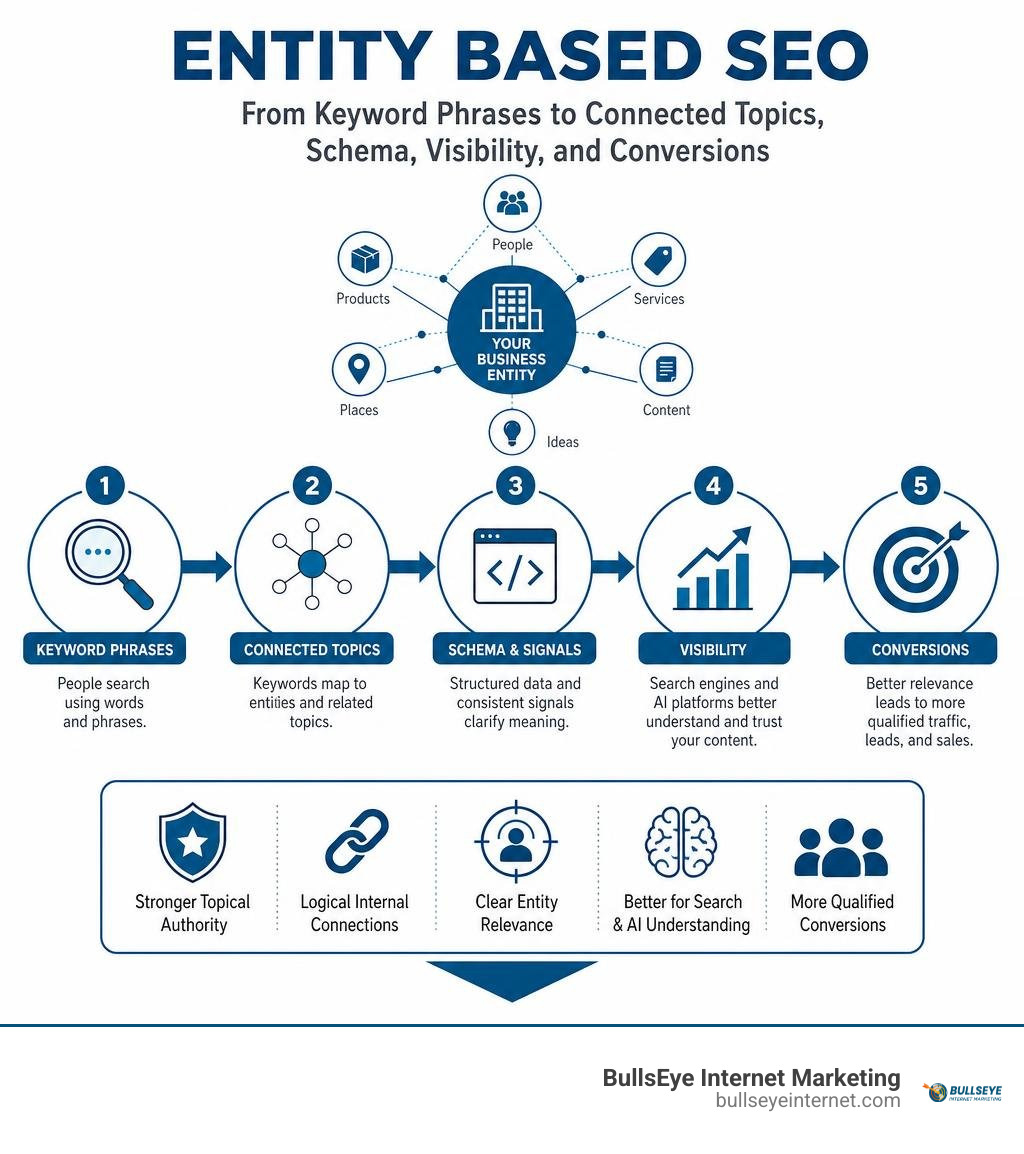
Entity based seo terms to remember:
Fundamentals of Entity Based SEO vs Traditional Keyword Optimization
For decades, search engine optimization operated on a flat map. Marketers found a high-volume search term, sprinkled it across title tags, headings, and body copy, and measured density. While this worked when search engines were literal indexers, modern search retrieval functions like a multidimensional constellation.
| Feature | Traditional Keyword SEO | Entity-Based SEO |
|---|---|---|
| Primary Focus | Exact-match text strings and search volume | Unique concepts, things, people, and places |
| Search Engine Mechanism | Inverted index string matching | Knowledge Graph mapping and vector embeddings |
| Context Handling | High risk of ambiguity (e.g., Apple fruit vs. Apple Inc.) | Algorithmic disambiguation using surrounding nodes |
| Algorithmic Resilience | Vulnerable to minor core updates and keyword shifts | Stable topical authority that compounds over time |
| AI Retrieval | Poor performance in conversational answers | Direct alignment with LLM retrieval and citation layers |
To succeed in organic search today, websites must transition from matching strings to aligning content with Google Knowledge Graph. Google’s Knowledge Graph houses billions of entities and trillions of facts. Search algorithms evaluate the conceptual nodes represented on your pages to confirm whether your brand is an authority on the topic.
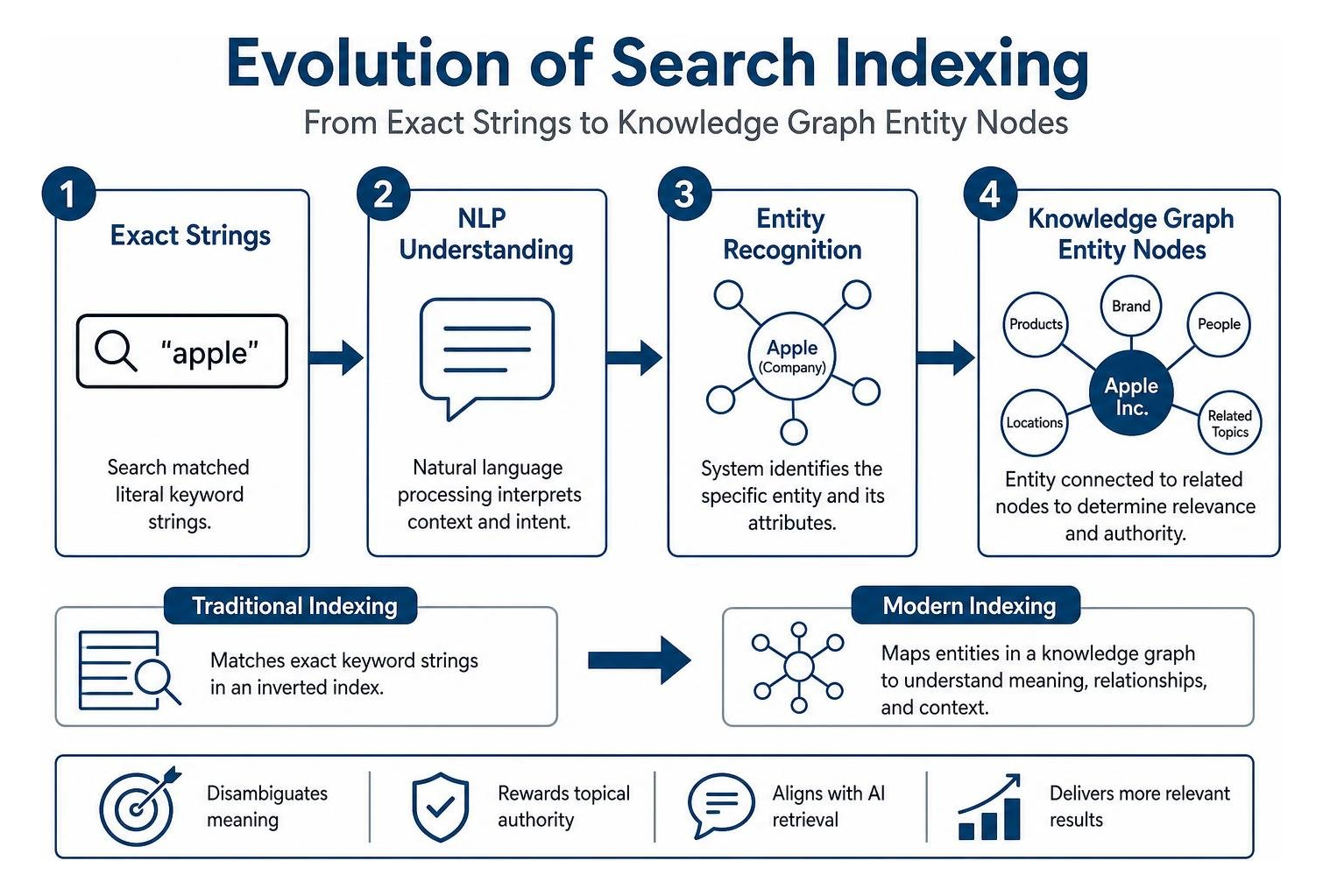
Core Principles of Entity Based SEO in Modern Search
The foundational shift in modern discovery centers on the philosophy of “things, not strings.” Rather than simply scanning for individual words, search engines evaluate the contextual relevance of your entire domain. When our team builds out comprehensive semantic SEO services, we focus on entity salience—a metric indicating how central a specific concept is to the core subject of the page.
By analyzing intent matching alongside entity attributes, algorithms can determine whether an article about “Mercury” is discussing the automotive brand, the planet, the chemical element, or the Roman god. Disambiguating these ideas requires surrounding the core entity with related conceptual attributes so algorithms can instantly verify the page’s topical integrity.
How Search Engines Extract Entities via NLP and Knowledge Graphs
Search engines process natural language through a multi-stage Natural Language Processing (NLP) pipeline. When an algorithm scans your copy, it performs tokenization, breaking sentences down into individual lexical components, followed by lemmatization to reduce words to their root forms.
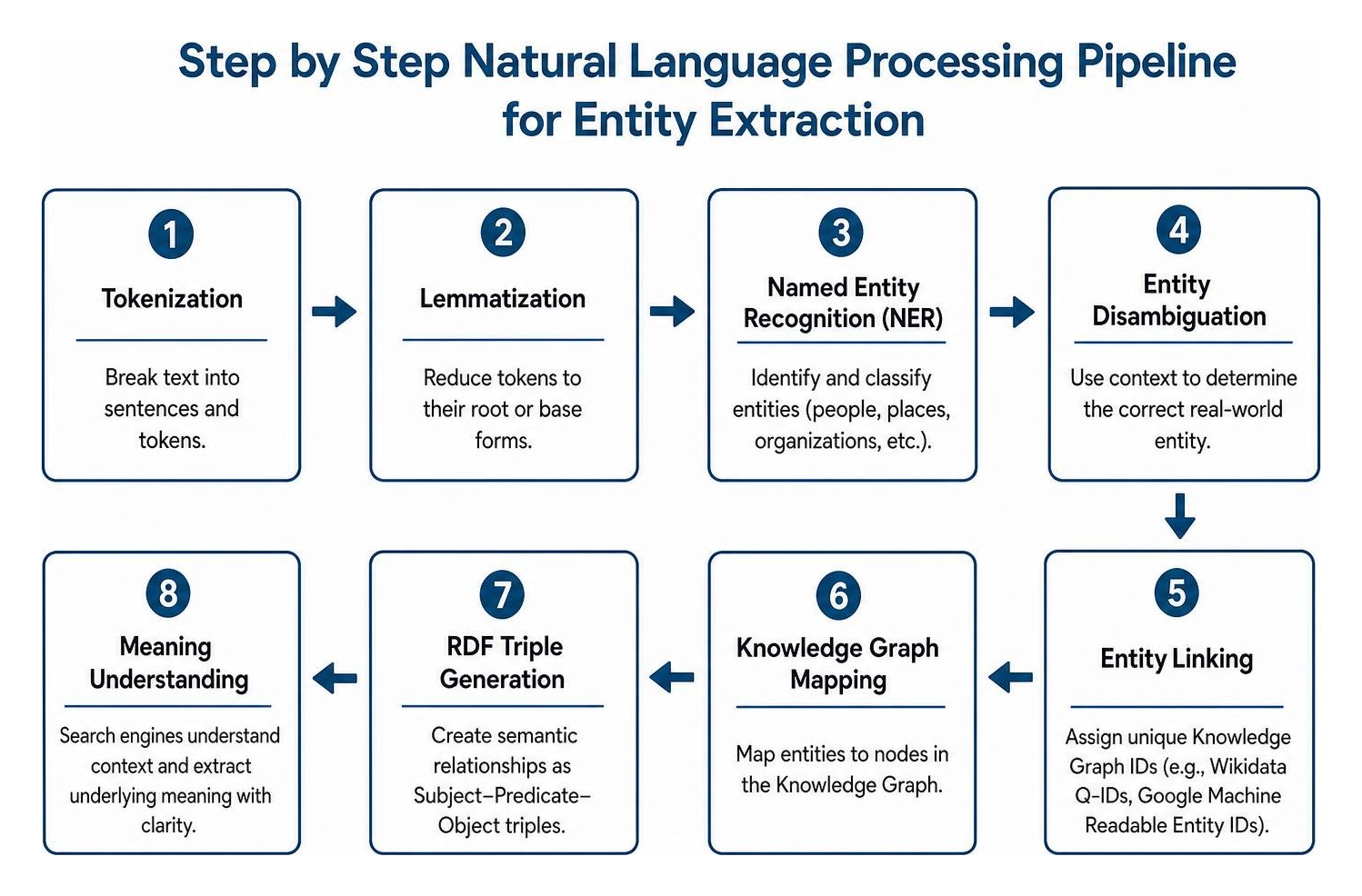
Advanced transformer models like BERT and MUM perform Named Entity Recognition (NER), classifying these terms into defined entity classes. Once recognized, these concepts are assigned unique Knowledge Graph IDs (such as Wikidata Q-IDs or Google Knowledge Graph Machine Readable Entity IDs). Search engines map these nodes using Resource Description Framework (RDF) triples—structured statements containing a subject, a predicate, and an object (e.g., [BullsEye Internet Marketing] to [provides] to [Search Engine Optimization]). These semantic relationships allow search systems to grasp underlying meaning with absolute clarity.
Building Topical Authority Through Entity Clusters and Structured Data

Relying on standalone, disconnected articles creates content silos that confuse search crawlers. To build lasting organic authority, websites must establish structured entity networks. By following an established guide to entity-based search optimization, you can design content architectures where every sub-page directly reinforces the semantic authority of the primary core entity.
How to Build Authority with an Entity Based SEO Framework
Building real authority requires organizing content into a hub-and-spoke architecture. You start with a comprehensive pillar page that defines a broad canonical entity, then support it with interconnected cluster nodes covering specialized subtopics.
When we focus on building topical authority, our framework implements bidirectional linking between the central pillar and its spokes. Using descriptive, contextual anchor text instead of generic phrases like “click here” signals the exact relationship between the two entities. This complete topical coverage prevents keyword cannibalization because each URL is assigned a distinct canonical entity node.
Maximizing Schema Markup and Entity Disambiguation
Structured data serves as the direct translator between your website and search engine knowledge bases. Implementing JSON-LD schema removes any guesswork regarding what your content represents.
Using explicit schema attributes like sameAs connects your web entities to external canonical databases such as Wikidata or Wikipedia. This direct linking is critical for securing Google rich results, as it confirms your business attributes, services, and locations without lexical ambiguity.
Establishing Brand Recognition in Google Knowledge Graph and AI Search
Securing a recognized entity status in Google’s Knowledge Graph shifts your brand from being an unverified website to a verified market authority. This recognition triggers Knowledge Panels, powers rich SERP inclusions, and ensures your company is cited as a trusted source within AI-driven search models.

Steps to Establish Entity Identity and Digital Footprint
To establish a durable entity footprint, businesses must reinforce consistent trust signals across every digital channel:
- Google Business Profile Optimization: Ensure complete, accurate categorization and localized data.
- Strict NAP Consistency: Maintain identical Name, Address, and Phone details across all web directories.
- Authoritative Entity Alignment: Link executives and organizations to verified Wikidata entries, industry associations, and reputable directories.
- Strategic Brand Mentions: Earn unlinked brand mentions across high-authority industry platforms and news publications, which AI models ingest as corroborating entity signals.
For businesses looking to capture conversational search traffic, deploying targeted large language model SEO strategies ensures that artificial intelligence platforms properly recognize your brand’s specific service niche and geographic footprint.
Avoiding Common Entity Optimization Pitfalls
Many optimization campaigns stumble due to foundational implementation errors. The most frequent mistakes include:
- Treating Schema as a Quick Fix: Adding structured data to thin, unhelpful content fails to build real authority.
- Inconsistent Entity Signals: Presenting conflicting company names, addresses, or service scopes across different platforms.
- Targeting Disconnected Topics: Publishing content on topics entirely outside your domain’s core semantic graph.
- Overlooking Internal Architecture: Leaving high-value subtopic pages orphaned without contextual links to their parent entity hubs.
Maintaining semantic alignment across all pages is essential when optimizing for generative engine visibility, ensuring that search engines and answer engines extract accurate facts about your organization.
Revenue Impact, Conversions, and Performance Measurement
Entity optimization is not merely an academic exercise in data modeling; it directly drives commercial performance. When search engines accurately understand your business offerings, they route highly qualified prospects with explicit commercial intent straight to your bottom-of-funnel service pages.
When partnering with us for full-service search engine optimization, companies gain an organic acquisition engine built around qualified buyers rather than vanity search volume.
Driving Conversions and Commercial Value
High-intent prospective clients rarely search for broad, single-word terms. Instead, they make specific, multi-faceted queries. Entity-optimized content hubs capture these complex queries because the site architecture directly mirrors the user’s decision-making process.
By answering every related sub-entity question—such as pricing, regional availability, service comparisons, and implementation steps—you establish immediate credibility. This comprehensive topical depth builds buyer trust, lowering friction and converting visitors into phone calls and scheduled consultations.
Tracking Entity Visibility, Salience, and ROI
Measuring the performance of an entity-based campaign requires moving beyond single keyword rank tracking. Stakeholders need to evaluate holistic topical health:
- Cluster-Level Visibility: Tracking aggregate organic impressions and clicks across entire content hubs within Google Search Console.
- Entity Salience Scores: Utilizing natural language processing tools to ensure target entities achieve salience scores above 0.7 on core pages.
- Knowledge Surface Presence: Monitoring the appearance of Knowledge Panels, Rich Snippets, and People Also Ask placements.
- Direct Commercial Output: Tracking phone calls, form completions, and qualified lead volume generated across the entire cluster network.
Frequently Asked Questions About Entity SEO
What is the difference between a keyword and an entity?
A keyword is a specific text string or phrase that a person enters into a search bar. An entity is a well-defined, singular concept—such as an organization, person, place, product, or distinct idea—that exists independently of language or exact phrasing. Entity SEO optimizes for the underlying concept and its real-world connections rather than simple keyword density.
How long does it take to see results from entity optimization?
Technical fixes such as structured data implementation and schema markup can generate rich result improvements within 2 to 4 weeks. Building comprehensive topical clusters and earning algorithmic trust across an entire entity network typically takes 3 to 6 months. Achieving full Knowledge Graph integration and panel verification generally occurs over a 6 to 12 month timeframe.
Do small businesses need entity optimization?
Yes. Entity optimization is critical for local service businesses. Setting up a fully optimized Google Business Profile, establishing complete NAP consistency across local directories, and adding localized schema markup establishes a verified local entity. This gives local companies a significant advantage in map pack rankings and localized search results.
Conclusion
The evolution of modern search algorithms toward semantic networks, knowledge graphs, and artificial intelligence models has fundamentally altered organic discovery. Brands that continue to rely on legacy keyword-stuffing tactics will struggle to maintain visibility in an increasingly context-driven ecosystem.
At BullsEye Internet Marketing, we protect our clients’ competitive edge by enforcing a strict market exclusivity policy: we work with only one client per industry per geographic area, and we offer all our services with no long-term contracts. Whether serving regional markets across Florida—from Miami-Dade, Broward, and Palm Beach County up through Martin, St. Lucie, and Indian River County—or businesses nationwide across all 50 states, our performance-driven approach ensures your business establishes commanding authority.
To establish your brand’s presence across modern search and AI platforms, explore our advanced answer engine optimization services and start building durable digital authority today.
