
Why GEO for Law Firms Cannot Wait
GEO for Law Firms means making your website, attorney profiles, and online business information easy for AI tools to understand, trust, and cite. Start by publishing clear answers to real client questions, showing attorney credentials and legal sources, using structured data, and keeping your firm details consistent across your site and legal directories.
This matters because legal search is changing fast. Google AI Overviews now appear for 77.67% of legal queries, while AI-generated answers can reduce clicks to the top-ranking organic page. Prospects are also asking ChatGPT, Claude, Gemini, and Perplexity questions such as, “Do I need a lawyer after a car accident?” or “Who handles wrongful termination cases near me?”
Your firm does not need to abandon SEO. It needs to add a new goal: becoming one of the reliable sources an AI system uses when it builds an answer. In a zero-click search world, a citation can put your practice on a prospective client’s shortlist before they ever visit a Google results page.
I am Ronnie Katz, founder and Principal CEO of BullsEye Internet Marketing, with more than 20 years of experience helping businesses earn more visibility, traffic, calls, and conversions online. My work in GEO for Law Firms combines SEO, local search, content strategy, structured data, and measurable reporting to help legal practices compete where clients now look for answers.
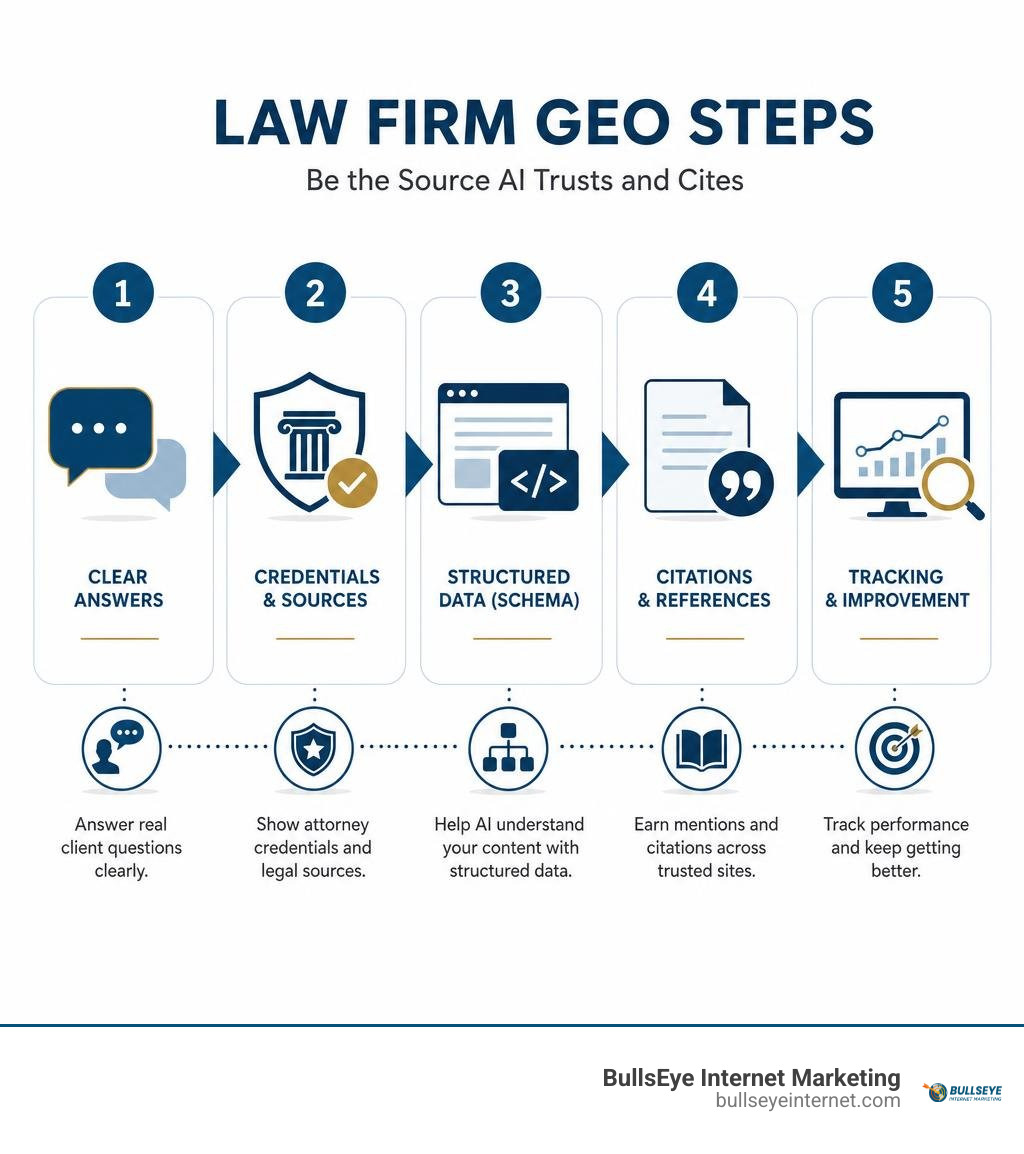
Explore more about GEO for Law Firms:
What Is GEO for Law Firms and How Does It Transform Search?
Generative Engine Optimization (GEO) is the practice of optimizing your firm’s digital footprint so that large language models (LLMs) and AI search platforms reference, recommend, and link to your firm. Traditional search engines crawl the web to index pages and rank a list of ten blue links. In contrast, generative engines ingest vast amounts of data, synthesize information across multiple sources, and present direct, cohesive answers to complex prompts.
To help conceptualize this shift, the generative search process functions across four primary stages:
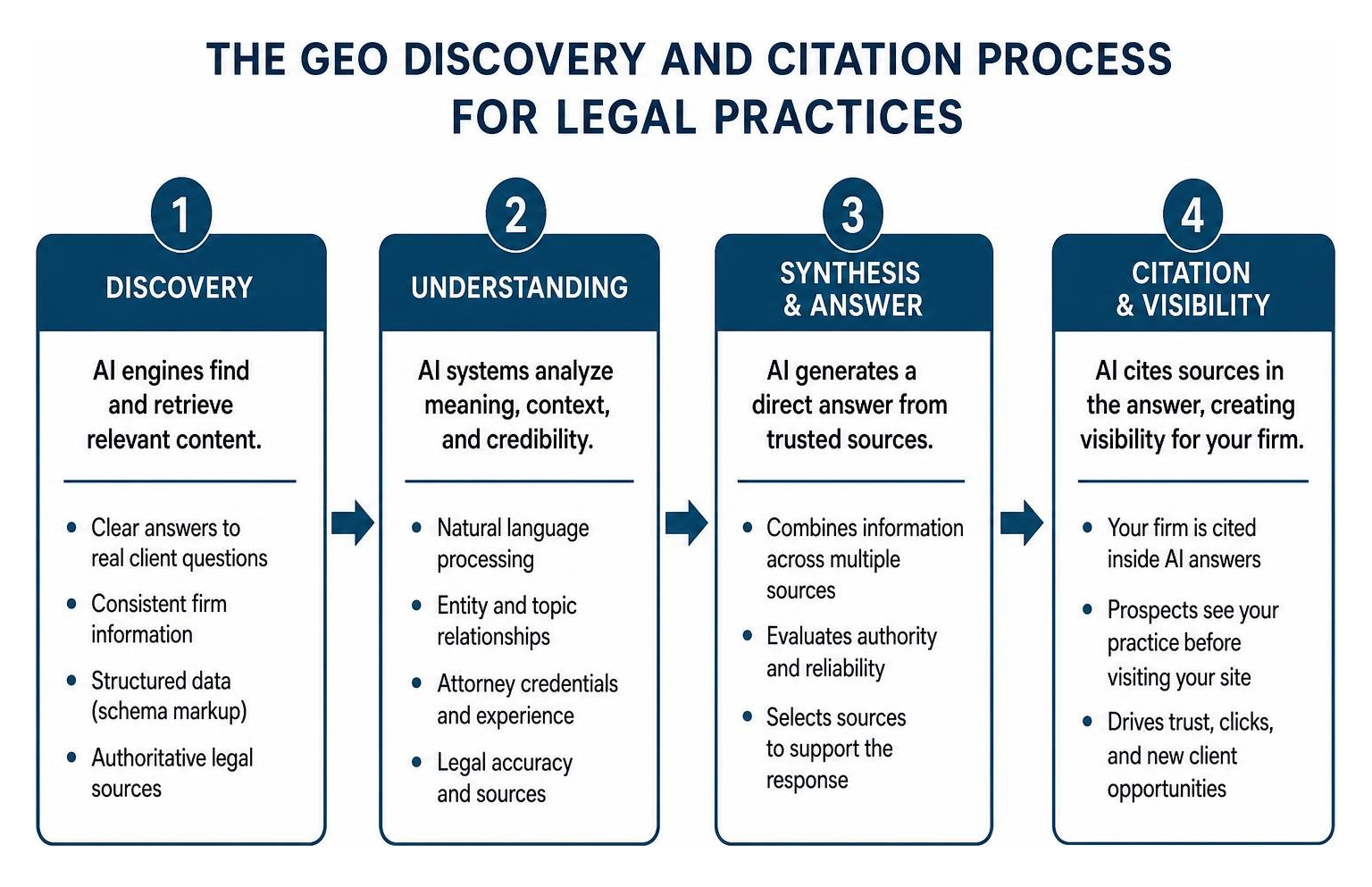
For decades, the standard objective of legal marketing was ranking in position #1 on Google for broad queries. Today, legal prospective clients often do not see traditional organic links unless they scroll past multi-paragraph AI answers. Generative engines evaluate content through natural language processing, entity relationships, and source verification. When your practice embraces these mechanics, you position your attorneys as the foundational source cited inside the generated answer.
Understanding how this shifts your strategy is essential. Consult our comprehensive AI Search Optimization Guide 2026 to see how algorithmic discovery is evolving.
| Marketing Dimension | Traditional Legal SEO | Generative Engine Optimization (GEO) |
|---|---|---|
| Primary Goal | Rank #1–3 on Search Engine Results Pages (SERPs) | Secure direct citations and inclusion in AI answers |
| User Experience | User clicks through a list of blue links | User reads synthesized answers with linked citations |
| Content Structure | Keyword-dense pages targeting specific search volumes | Question-and-answer formats, authoritative definitions, and structured data |
| Key Metric | Organic clicks, impressions, and keyword rankings | Citation share of voice, prompt visibility, and qualified legal leads |
| Platform Scope | Traditional search engines (Google, Bing) | LLMs and hybrid engines (ChatGPT, Claude, Gemini, Perplexity, AI Overviews) |
Traditional Legal SEO vs Generative Engine Optimization
Traditional legal search engine optimization relies heavily on matching target keywords, acquiring backlinks, and optimizing page load speeds to secure top SERP placements. While these fundamentals remain valuable, the commercial landscape has shifted dramatically. When a Google AI Overview appears at the top of a search result, studies reveal it correlates with a 58% lower average click-through rate for the top-ranking organic page.
More than half of all Google searches now conclude without a single click to any external website. If a user asks a complex question about comparative negligence, Google synthesizes the answer immediately. If your firm is merely ranking below that synthesized box, your exposure drops. Adopting Next Gen SEO strategies ensures that your firm is the recognized authority fueling that answer rather than an overlooked link beneath it.
Distinguishing Between GEO and AEO in Legal Marketing
While marketers frequently use GEO and AEO interchangeably, distinct differences exist between them:
- Answer Engine Optimization (AEO) focuses primarily on optimizing content to win direct-answer features within traditional search engines, including Google Featured Snippets, “People Also Ask” accordions, and Knowledge Panels.
- Generative Engine Optimization (GEO) focuses on multi-sentence synthesis, conversational exploration, and deep source attribution across conversational AI engines like ChatGPT, Anthropic’s Claude, and Perplexity.
AEO provides concise, single-layer factual responses to discrete inquiries. GEO handles complex, multi-layered legal scenarios where prospective clients ask follow-up questions, describe unique circumstances, and demand nuanced evaluations. To dive deeper into these distinctions, explore our detailed guide on What is AEO.
Why Generative AI Visibility Is Critical for Attorneys in 2026
The legal sector has experienced a profound shift in consumer search behavior. Data indicates that 28% of consumers actively use AI tools to research professional services before making direct contact. LLM-referred traffic to legal websites more than doubled between early 2024 and mid-2025, and AI-generated answers now appear in 16.48% of all U.S. Google searches—more than double their footprint from early 2025.
Legal matters carry high emotional and financial stakes. When prospective clients seek counsel, they no longer rely solely on generic directory listings or basic keyword searches. They use AI models as interactive advisors to evaluate legal scenarios, compare practice areas, and assemble shortlists of qualified firms. Studies exploring The Changing Economic Geography of Large U.S. Law Firms reflect how modern practices must adapt their geographic visibility to where clients actually convene—which is increasingly inside conversational AI ecosystems.
How Legal Consumers Use ChatGPT, Claude, Gemini, and Perplexity
Modern legal prospects interact with generative search engines using natural, conversational language. Instead of typing fragmented keywords like “car accident lawyer Miami,” a user will prompt ChatGPT:
“I was rear-ended on I-95 in Fort Lauderdale by a commercial truck driver who was speeding. The insurance adjuster is offering a quick settlement, but my neck still hurts. What are my legal rights under Florida comparative fault laws, and what should I look for in an attorney to handle this?”

With ChatGPT commanding over 200 million weekly active users globally, and Perplexity growing at approximately 40% month-over-month, conversational research has become mainstream. Anthropic’s Economic Index highlights that administrative, financial, sales, and management tasks represent nearly 29% of Claude Cowork usage, demonstrating how routinely professionals and consumers leverage AI for complex decision-making.
When users engage in multi-turn dialogues with LLMs, the AI recommends specific firms that possess clear, verified topical authority in that jurisdiction. As we explore in Talk Is Cheap but Conversational AI SEO Is Gold, adapting to conversational search patterns captures high-intent prospects precisely when they are ready to retain counsel.
The Dominance of AI Overviews in Legal Query Results
Google AI Overviews trigger on 77.67% of legal search queries—the highest rate of any industry vertical. Because legal inquiries represent informational, high-stakes questions, Google’s algorithms prioritize synthesized overviews that summarize statutes, procedures, and options.
Firms that fail to optimize for generative engines risk disappearing from consumer view, as these overviews dominate above-the-fold real estate on both mobile and desktop screens. To preserve and grow your client pipeline, mastering Mastering Google SGE Your Path to AI Search Visibility is an urgent operational priority.
Core Ranking Factors in GEO for Law Firms
Generative engines do not rely on traditional PageRank alone. They determine citation-worthiness using specialized computational frameworks that evaluate topical authority, factual clarity, structural readability, and verified entity relationships.
To ensure your practice earns top-tier citations, our breakdown of AI Search Ranking Factors outlines how LLMs evaluate authority. Being listed in authoritative directories, such as the Best Lawyers in Martin County, FL – Justia directory, helps establish the verified external footprint that generative models cross-reference during response generation.
Structured Data, Schema Markup, and Entity Consistency
LLMs ingest vast quantities of unstructured text, but they rely heavily on structured data to verify facts without ambiguity. Schema markup serves as machine-readable translation for AI crawlers, explicitly defining who you are, what you practice, and where you are licensed.
To maximize your firm’s AI readability, implement these nested schema types:
LegalServiceandAttorneyschemas: Define specific attorney names, bar admissions, physical office locations, and operational hours.FAQPageschema: Mark up direct question-and-answer pairs to provide extractable summaries for direct quotation.AboutPageandProfilePageschemas: Explicitly link attorney profiles to verified third-party entities such as State Bar profiles and legal associations.
Equally critical is absolute entity consistency across the digital ecosystem. Your firm’s Name, Address, Phone number (NAP), founding dates, and partner rosters must align across your website, Google Business Profile, local bar associations, and state licensing portals. Discrepancies introduce algorithmic doubt, causing LLMs to bypass your firm in favor of a competitor with clearer entity signals. Implementing robust AI Visibility Optimization ensures seamless data uniformity across all touchpoints.
E-E-A-T Signals, Author Credentials, and Primary Sources
Google and third-party LLMs apply rigorous Experience, Expertise, Authoritativeness, and Trustworthiness (E-E-A-T) standards to “Your Money or Your Life” (YMYL) legal content. To be deemed a safe source for AI quotation, your content must show clear proof of legal expertise:
- Verified Attorney Bylines: Every legal article must include a clear byline identifying the author, their Juris Doctor degree, bar admissions, years of practice, and specific practice specializations.
- Primary Source Citations: Ground legal advice in direct references to state statutes, administrative codes, and recent appellate rulings.
- Decisive Legal Analysis: Generative engines favor content that takes clear, authoritative positions on procedural timelines, damage caps, and filing requirements rather than vague generalities.
Structuring your firm’s thought leadership around genuine practitioner insights is outlined in A Practical Guide to LLM SEO Strategies.
Actionable Steps to Implement GEO for Law Firms
Transforming your law firm’s digital assets into an AI-cited authority requires a systematic execution plan:
- Verify AI Crawler Accessibility: Review your server settings and
robots.txtconfiguration to confirm you are not accidentally blocking primary AI user agents such asGPTBot,ClaudeBot,PerplexityBot, andGoogle-Extended. - Perform an AI Visibility Audit: Prompt major AI models (ChatGPT, Claude, Gemini, Perplexity) with 20–30 long-tail queries covering your core practice areas and target geographic markets to evaluate your current citation share.
- Restructure Practice Content into Extractable Units: Reorganize service pages so that each section leads with a concise 40-to-60-word direct answer before delving into deeper statutory analysis.
- Deploy Advanced Schema Markup: Inject comprehensive JSON-LD structured data across all attorney bios, practice pages, and legal guides.
- Harmonize Legal Directory Profiles: Synchronize your firm’s details across major legal platforms, ensuring that practice categories and office locations match identically.
To tailor your content architecture for LLM processing, implement the methods described in Speak the AIs Language Optimizing Content for Large Language Models.
Optimizing Content Architecture Without Disrupting Existing SEO
You do not need to tear down your existing site architecture to succeed in generative search. GEO enhancements naturally complement and reinforce traditional SEO foundations.
Build comprehensive topic clusters organized around practice area pillar pages. A personal injury pillar page, for instance, should seamlessly link to specialized subtopic pages covering commercial trucking liability, pedestrian accidents, and wrongful death claims.
Within each subtopic page, integrate clear heading hierarchies (H2, H3) phrased as natural-language questions. Directly beneath each heading, provide an immediate, standalone answer paragraph. This format provides traditional search engines with clear relevance signals while handing AI engines self-contained, quotable passages ready for immediate extraction. Learn more about foundational regional structuring in our Step by Step Guide to Local Attorney SEO.
Tracking AI Citations, Share of Voice, and Legal Leads
Measuring GEO performance requires tracking beyond conventional keyword rankings. Because AI engines assemble personalized responses on the fly, tracking focuses on citation frequency, sentiment, and query coverage.

Key performance metrics to monitor monthly include:
- Citation Frequency: The percentage of relevant practice-area prompts where your law firm is explicitly named or linked as a supporting source.
- Citation Position: Whether your firm is presented as the primary recommended authority or listed among secondary references.
- LLM Referral Traffic: Tracking visitors navigating to your site directly from AI interfaces using analytics tracking parameters.
- Inbound Call Attribution: Documenting intake inquiries where prospective clients state they found your firm via ChatGPT, Gemini, or Perplexity recommendations.
For an extensive analysis of tracking frameworks, review our AI Search Marketing Agency Guide.
Navigating In-House Capabilities vs Specialized Agency Partnership
Law firm partners often ask whether they should manage GEO in-house or partner with an agency. The right choice depends on your internal marketing bandwidth and technical expertise.
Managing GEO entirely in-house requires your internal staff to master complex schema architecture, continuously track AI crawler updates, execute monthly prompt audits, and draft content with legal precision. For most firms, pulling senior attorneys away from billable caseloads to write structured FAQ blocks is inefficient.
Partnering with a specialized agency provides immediate access to proven technical frameworks, advanced LLM tracking tools, and experienced legal copywriters who know how to showcase E-E-A-T signals.
At BullsEye Internet Marketing, we deliver a distinct competitive edge: we work with only one law firm per practice area in any geographic market, and we never lock our clients into long-term contracts. This exclusive arrangement ensures our team focuses entirely on securing dominant AI visibility for your practice—without conflicting loyalties. Explore our strategic framework in the Law Firm Marketing Guide 2026.
Frequently Asked Questions About Legal GEO
Can a Law Firm Control What AI Models State About Their Practice?
A law firm cannot directly edit or hardcode what an AI model generates. However, you can guide what AI models say by managing your digital footprint. Large language models reflect the consensus of their training data and real-time retrieval-augmented generation (RAG) feeds.
By publishing verified case summaries, maintaining structured bios, securing verified client reviews, and enforcing absolute NAP consistency across state bar directories, you provide the authoritative data points LLMs use to describe your practice accurately and mitigate hallucinations.
How Quickly Can Attorneys Expect Results from Generative Engine Optimization?
While traditional SEO can take six to twelve months to build domain authority, GEO improvements often yield observable citation movement faster—typically within 60 to 90 days.
Real-time retrieval engines like Perplexity, Google AI Overviews, and search-enabled ChatGPT crawl and index structured Q&A content and schema markup rapidly. Once your site’s technical crawl barriers are cleared and clear answer formats are published, generative engines can extract your content during live query synthesis almost immediately.
Does Investing in GEO Require Abandoning Traditional Legal SEO?
No. GEO is an evolution of search optimization, not an entirely separate replacement. Generative search engines still utilize core search infrastructure—such as page crawlability, internal linking, high-quality backlinks, and topical depth—to evaluate source credibility.
A modern legal marketing strategy combines technical SEO, Local Service Ads (LSA), Google Business Profile optimization, and GEO into a unified approach that captures both traditional searchers and conversational AI users.
Conclusion: Securing Your Practice’s Future in the Generative Search Era
The rapid rise of generative engines represents the most significant shift in legal marketing since the transition from phone directories to Google search. With AI Overviews dominating over three-quarters of legal queries, waiting to adapt is no longer a viable option. Practices that establish their entity authority and optimize their content for LLM extraction today will own their local markets for years to come.
At BullsEye Internet Marketing, we help law firms lead this new era through data-backed Pay Per Lead strategies, local search optimization, and advanced Generative Engine Optimization. With our commitment to client exclusivity—representing only one client per industry per geographic area—and our no-long-term-contract model, we partner with you to achieve sustainable growth.
Take the first step toward dominating AI-driven search results. Explore our specialized Answer Engine Optimization AEO GEO LLM SEO solutions and claim your geographic market before your competitors do.
