
Why Most Startups Fail Before Anyone Hears of Them
Advertising for startups is the process of using paid and organic channels to build brand awareness, attract customers, and drive revenue — before you have an established reputation to lean on.
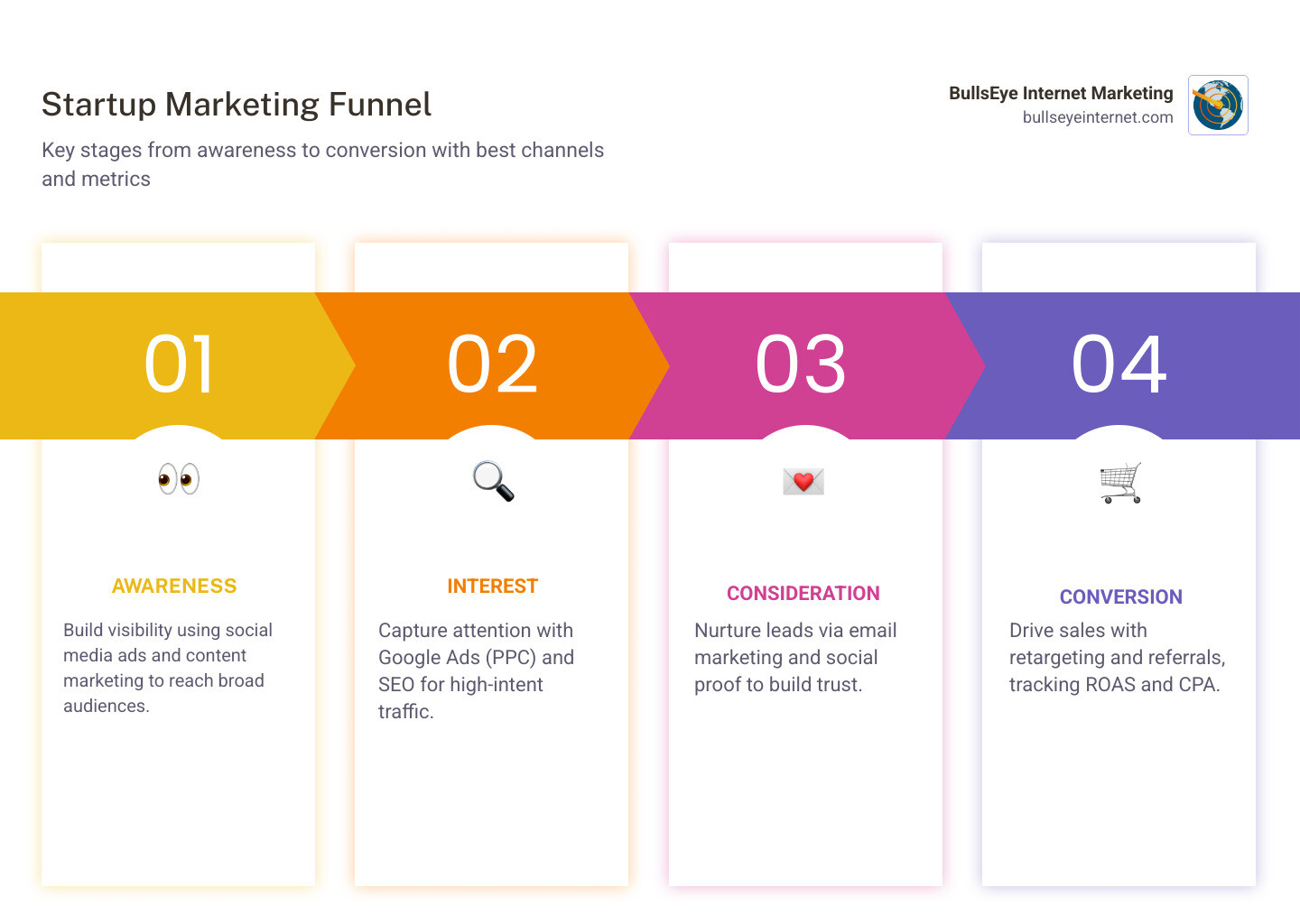
Here’s a quick breakdown of what works:
| Goal | Best Channel |
|---|---|
| Build brand awareness | Social media ads, content marketing |
| Capture high-intent buyers | Google Ads (PPC), SEO |
| Nurture leads over time | Email marketing |
| Build trust fast | Social proof, influencer marketing |
| Scale on a tight budget | Retargeting, referral programs |
Startups don’t have the luxury of time. Around 90% of startups fail — and a big reason is failing to connect with the right audience early enough. In fact, 22% of startups fail specifically because of marketing problems. That’s not a product problem. That’s a visibility problem.
The hard truth? You can have a great product and still go broke if nobody knows it exists.
Getting your first customers requires more than a logo and a landing page. It requires a deliberate strategy — one that targets the right people, on the right channels, with the right message, at the right time.
And the cost of waiting? It compounds. Every week without a clear ad strategy is a week your competitors are capturing the customers who should be yours.
I’m Ronnie Katz, founder of BullsEye Internet Marketing, and since 2006 I’ve helped businesses across competitive industries build smarter advertising for startups and growing companies through SEO, PPC, and conversion-focused digital strategies. In this guide, I’ll walk you through exactly what you need to get your startup in front of the right people — without burning your budget.
The Core Pillars of Advertising for Startups
When we talk about advertising for startups, we aren’t just talking about throwing money at a “Boost Post” button on Facebook and hoping for the best. For a new business, every dollar is a seed that needs to grow into a customer. Unlike established giants who spend millions on “brand sentiment,” startups need to focus on direct response and measurable customer acquisition.
As mentioned, 22% of startups fail due to marketing problems. This usually happens because they build a product in a vacuum and then realize they have no way to reach the people who need it. To avoid this, we focus on three foundational elements: a rock-solid brand identity, a clear value proposition, and a deep understanding of who you are actually talking to.
Defining Your Ideal Customer Profile
You cannot target everyone. If you try to sell to “everyone with a smartphone,” you will go broke before you hit your first 1,000 users. Effective market research involves digging into the psychographics (values, fears, desires) and demographics (age, location, job title) of your early adopters.
To get started, we recommend using a detailed guide on buyer personas to map out exactly who your customer is. Ask yourself:
- What keeps them up at night?
- Where do they hang out online (Reddit? LinkedIn? TikTok?)?
- What is the specific “pain point” your startup solves?
Setting SMART Advertising Goals
“I want more sales” is a wish, not a goal. In our work with clients across Florida and the US, we emphasize SMART goals: Specific, Measurable, Achievable, Relevant, and Time-bound.
Instead of “getting traffic,” aim for “generating 50 qualified leads at a cost-per-lead of $20 by the end of Q3.” Tracking conversion rates and revenue targets is essential. Furthermore, as you grow, you must protect what you’ve built. Maintaining a positive image is vital, which is why brand reputation management for startups should be part of your strategy from day one.

Choosing the Right Channels for Your Growth Stage
The biggest mistake we see startups make is trying to be everywhere at once. You don’t need a podcast, a TikTok channel, a LinkedIn newsletter, and a billboard in Miami all at the same time. You need to pick the channels that match your growth stage and where your audience actually lives.
For example, there are several advertising options on X that allow you to target based on keywords people use in their posts. If you are a B2B SaaS company, LinkedIn ads for professionals are excellent because you can target by job title and industry. However, for long-term, sustainable growth, SEO for startups is often the most cost-effective way to build an organic engine that brings in leads while you sleep.
Search Engine Marketing and Intent
Search engines like Google are “intent-based” platforms. When someone types “best accounting software for startups” into a search bar, they are telling you they have a problem they want to solve right now.
This is where Pay-Per-Click (PPC) and SEO shine. Did you know that organic search (SEO) can have a high conversion rate of 14.6%? While SEO takes time to build, you can use Google Ads for startups to jump to the top of the results page immediately. This allows you to test which keywords actually lead to sales before you invest months into content creation.
Social Media and Community Building
While search is about intent, social media is about discovery and trust. Research shows that 74% of consumers trust social media opinions when making a purchase. Startups can leverage influencer marketing or community engagement to build “social proof.”
However, all that social traffic is wasted if your “digital storefront” is a mess. A new business website design that is optimized for mobile and built to convert is the “engine” that turns social followers into paying customers.
Budgeting and Tracking: How to Advertise Your Startup Without Wasting Money
One of the most common questions we hear is: “How much should I spend?” There is no one-size-fits-all answer, but there are proven frameworks. A typical marketing budget for a startup ranges from 5% to 15% of revenue. If you are pre-revenue, you have to look at your “runway” and decide how much you can afford to lose while testing.
In B2B startup marketing, the sales cycle is longer, so your budget needs to account for multiple “touches” before a deal closes.
Budgeting for Advertising for Startups
| Stage | Typical Monthly Ad Spend | Primary Focus |
|---|---|---|
| Bootstrap | $500 – $1,500 | High-intent search, Retargeting, Content |
| Seed Stage | $2,000 – $10,000 | Scaling winning channels, Influencers |
| Series A+ | $15,000 – $100k+ | Multi-channel dominance, Brand building |
At the bootstrap stage, focus on “bottom-of-the-funnel” tactics. This means targeting people who are already looking for a solution like yours. As you move to the Seed and Series A stages, you can afford to spend more on “top-of-the-funnel” awareness to fill your pipeline.
Essential KPIs to Monitor
If you don’t track your data, you are just gambling. You need to know your:
- Customer Lifetime Value (CLV): How much is a customer worth over the next 2 years?
- Cost Per Acquisition (CPA): How much did you spend in ads to get that one customer?
- Click-Through Rate (CTR): Are your ads actually interesting enough to click?
If your CPA is higher than your CLV, your startup is a “leaky bucket.” You need to fix your conversion process before spending more on ads.
Leveraging AI and Low-Cost Tactics for Maximum Impact
We live in the golden age of “scrappy” marketing. You no longer need a 10-person creative team to launch a campaign. Tools like ChatGPT for creative copy can help you brainstorm headlines and ad variations in seconds. Similarly, Google Workspace AI can assist with data analysis and reporting.
Using these tools allows you to focus on high-impact advertising for startups strategies like retargeting. Retargeting is when you show ads to people who have already visited your site but didn’t buy. It is often the highest-ROI ad spend because you are talking to a “warm” audience.
Scaling Your Advertising for Startups
Once you find a campaign that works, how do you scale it? We often use “Lookalike Audiences.” This is where you give an ad platform (like Meta) a list of your current customers, and the AI finds millions of other people who “look” like them.
To keep performance high, you must constantly perform A/B testing — changing one variable (like a headline or image) to see which performs better. This prevents “creative fatigue,” where people stop seeing your ads because they’ve become part of the digital wallpaper.
Don’t ignore the “old school” channels either. Email marketing drives an ROI of $36 for every $1 spent. It remains the king of conversion for a reason.
Free and Low-Cost Growth Levers
If your budget is near zero, you have to trade money for “hustle.”
- Building in Public: Share your journey on X or LinkedIn. People love to support a founder with a story.
- Referral Programs: Give your current users a reason to invite their friends (think of the early Dropbox storage incentives).
- Guest Posting: Write for industry blogs to borrow their audience and build SEO backlinks.
Common Pitfalls and Legal Compliance in Startup Ads
The fastest way to kill a startup isn’t a bad ad — it’s a lawsuit or a platform ban. Many founders “spray and pray,” sending ads to the wrong people and getting flagged as spam. Precision targeting isn’t just about efficiency; it’s about protecting your brand’s digital health.
You also need to be aware of the rules. If you have customers in Europe, you must comply with the General Data Protection Regulation (GDPR). If you are doing email marketing in the US, you must follow CAN-SPAM Act compliance, which includes having a clear “unsubscribe” link.
Avoiding the “Spray and Pray” Method
Don’t just target “Interest: Business.” Target “Job Title: Marketing Manager” at companies with 10-50 employees. The more precise your targeting, the less money you waste. Also, ensure your legal house is in order. Using professional templates for your terms of service and privacy policies is a non-negotiable step for any serious startup.
Adhering to Advertising Standards
The FTC is very clear about federal advertising standards. Your ads must be truthful and not misleading. If you are using influencers, they must disclose that they are being paid. “Fake it ’til you make it” does not apply to legal disclosures.
Frequently Asked Questions about Advertising for Startups
When should a startup start paid advertising?
You should start paid advertising as soon as you have a “minimum viable product” and a way to accept payments. However, don’t scale your spend until you have seen “product-market fit” — meaning people are actually using and liking what you built. Use early ads as a “testing phase” to see which messages resonate.
What is a typical marketing budget for a new startup?
As a rule of thumb, aim for 5% to 15% of your revenue. If you are in a high-growth phase or a very competitive market (like SaaS or FinTech), you might spend significantly more to capture market share. The key is resource efficiency; every dollar must be tracked against a result.
Which advertising channel is most effective for B2B startups?
LinkedIn Ads are generally the most effective for B2B because of the professional targeting data. However, Google Search is a close second because it captures people at the exact moment they are searching for a business solution. Direct outreach (cold email or LinkedIn messaging) is also highly effective for early-stage B2B traction.
Conclusion
Advertising for startups is a marathon, not a sprint — but you have to start running today if you want to win. The digital landscape is more competitive than ever, and “hoping for word of mouth” is a recipe for joining the 90% of startups that don’t make it.
At BullsEye Internet Marketing, we understand the unique pressure founders face. We don’t believe in locking you into long-term contracts. We believe in earning your business every single month through results. Whether you are in Miami, West Palm Beach, or anywhere across the US, we offer a competitive advantage by working with only one client per industry per geographic area.
We specialize in Pay-Per-Lead models, SEO, and PPC strategies that are built to generate calls and sales, not just “likes.” Ready to stop shouting into the void and start growing? Find more info about our digital marketing services and let’s build your growth engine together.
