
Why Personal Injury PPC Demands a Smarter Budget
Personal injury PPC helps law firms place ads in front of people actively searching for an accident lawyer, but it is one of Google’s most costly and competitive ad markets. Winning is less about buying the most clicks and more about buying the right clicks, turning them into qualified consultations, and connecting every lead to a signed case.
| What to focus on | Why it matters |
|---|---|
| Claim-specific keywords | “Truck accident lawyer” and “car accident lawyer” often attract different case values and searchers. |
| Tight local targeting | You should not pay for clicks outside the states, cities, or service areas where your firm can take cases. |
| Dedicated landing pages | A focused page that matches the ad can turn more paid visitors into calls and form leads. |
| Lead qualification | Clear ad copy reduces clicks from people with claims your firm cannot accept. |
| Cost per retained case | A low cost per lead means little if those leads do not become clients. |
The stakes are high. Legal PPC averages about $181 per click nationally for competitive terms, and pricing can vary sharply by market. Some personal injury keywords cost hundreds of dollars per click, so weak targeting, broad keywords, slow intake, or a generic homepage can burn through a budget fast.
The opportunity is equally real: search ads can put a firm in front of high-intent prospects at the exact moment they need help. This guide explains how to make that visibility produce measurable case value rather than expensive, unqualified traffic.
I am Ronnie Katz, founder and Principal CEO of BullsEye Internet Marketing, with more than 20 years of experience helping businesses increase qualified traffic, calls, and conversions. My work in Personal injury PPC centers on transparent tracking and practical campaign improvements that tie ad spend to real business results.
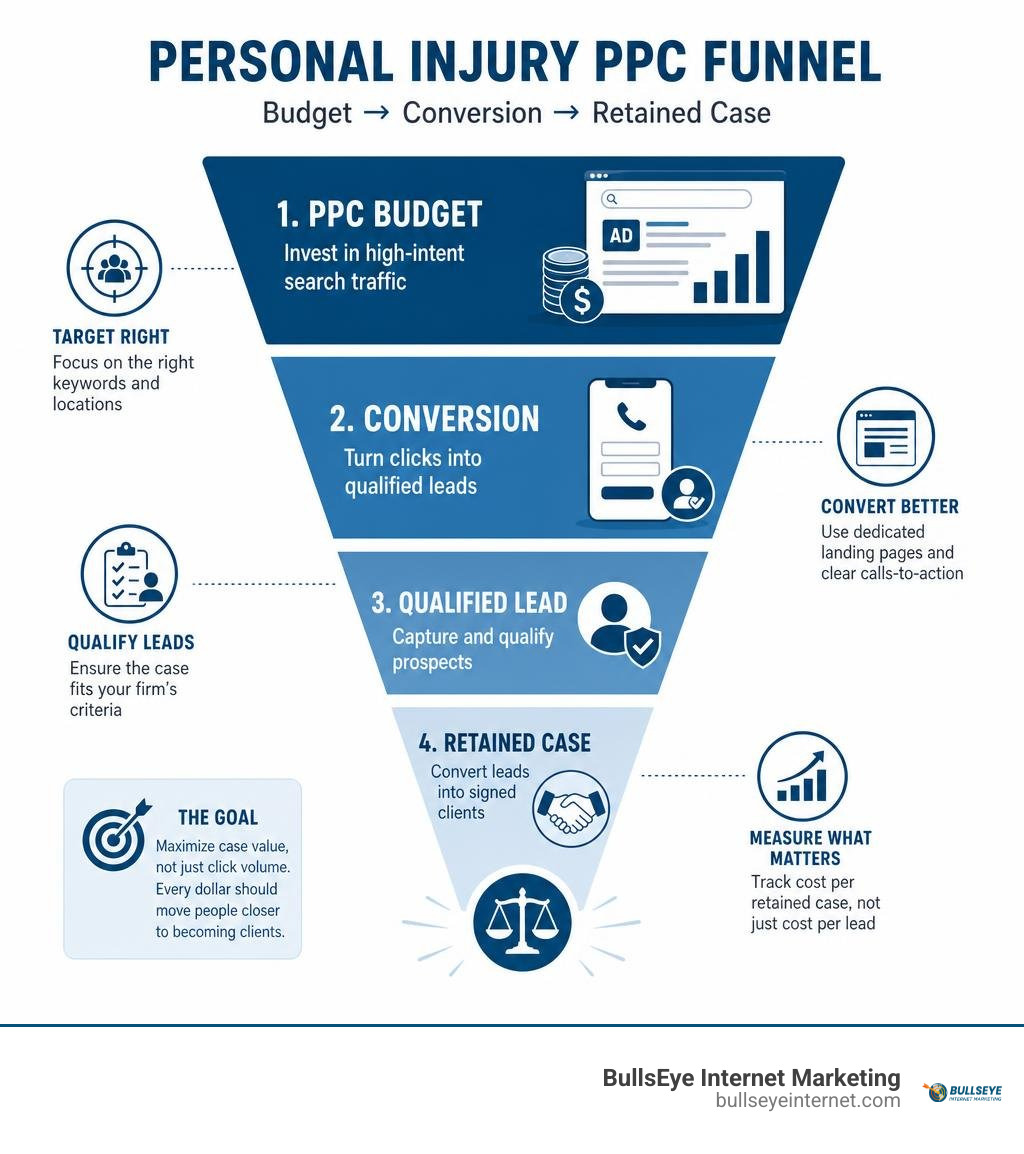
Personal injury PPC vocab explained:
The Economics of Personal Injury PPC: CPCs, Case Values, and ROI
To master personal injury PPC, you first need to understand the unusual unit economics of legal search advertising. Why are cost-per-click (CPC) rates in personal injury among the highest across the entire web? The answer lies in average case settlements and legal fee structures.
When a single catastrophic injury or commercial vehicle accident case can yield tens or hundreds of thousands of dollars in attorney fees, law firms are willing to bid aggressively to acquire that client. A firm that signs a $500,000 settlement with a standard 33% contingency fee generates over $160,000 in revenue. Spending $5,000 or even $10,000 in ad click budget to acquire that single client yields an extraordinary return on investment.
However, national averages can be deceptive. While the national average CPC for general law firm search terms hovers around $181, pricing fluctuates wildly based on geographic competition and intent:
- High-density or litigious metropolitan markets often see core terms like “car accident attorney” priced between $100 and $300+ per click.
- Highly competitive regional pockets see extreme spikes, with specific keywords reaching several hundred dollars per single click.
- High-intent commercial terms like “truck accident lawyer” or “wrongful death attorney” command premium pricing because average settlement values are higher than standard fender-benders.
Firms that treat Google Ads as a simple game of spending the most money often run into financial friction. Without rigorous tracking, an unoptimized campaign can easily burn through thousands of dollars in a few days while generating nothing more than unqualified phone calls for minor property damage, wrong numbers, or out-of-jurisdiction incidents.
To achieve consistent ROI, law firms must stop looking at PPC as an expense and start evaluating it through financial engineering. For a comprehensive overview of setting up legal ad budgets, explore our Detailed Guide to Google Ads for Lawyers.
Calculating Max Target CPC in Personal Injury PPC
Before launching or restructuring a personal injury PPC account, you must work backward from your firm’s financial fundamentals to establish your Maximum Allowable Cost-Per-Click (Max Target CPC). Setting bids without this baseline is equivalent to writing a blank check to auction platforms.
To find your Max Target CPC, you need four key data points:
- Average Legal Fee per Retained Case ($): The expected firm revenue generated from an average signed case.
- Target Acquisition Cost Percentage (%): The maximum percentage of legal revenue you are willing to spend to acquire a client (typically 15% to 25% for aggressive growth).
- Lead-to-Case Close Rate (%): The percentage of incoming form fills and phone calls that convert into signed representation agreements after intake evaluation.
- Landing Page Conversion Rate (%): The percentage of ad clicks that convert into an inbound phone call or form submission.
The formula works as follows:
Target Acquisition Cost (TAC) = Average Legal Fee x Target Acquisition %
Target Cost Per Lead (CPL) = Target Acquisition Cost x Lead-to-Case Close Rate
Max Target CPC = Target CPL x Landing Page Conversion Rate
Here is how varying case values, close rates, and conversion efficiencies impact what a firm can afford to bid per click:
| Case Category | Avg. Legal Fee Revenue | Target Acq. Cost (20%) | Lead-to-Case Close Rate | Target CPL | Landing Page Conv. Rate | Max Target CPC |
|---|---|---|---|---|---|---|
| Auto Accident (Standard) | $6,000 | $1,200 | 15% | $180 | 10% | $18.00 |
| Auto Accident (High Efficiency) | $8,000 | $1,600 | 25% | $400 | 15% | $60.00 |
| Truck/Commercial Vehicle | $25,000 | $5,000 | 20% | $1,000 | 12% | $120.00 |
| Complex Practice / Malpractice | $40,000 | $8,000 | 10% | $800 | 8% | $64.00 |
Understanding these mechanics prevents your firm from overbidding on low-yield keywords while giving you the confidence to bid aggressively on transformational case categories.
Campaign Architecture: Structuring for Maximum Efficiency
A frequent mistake in personal injury PPC is lumping multiple injury practice areas into a single campaign or ad group. When “slip and fall,” “car accident,” “motorcycle crash,” and “dog bite” search terms share the same daily budget and ad copy, ad relevance plummets, Quality Scores drop, and CPC costs rise.
To maximize control and campaign relevance, we structure accounts using strict claim-type segmentation:

- Car Accident Campaigns: Focused on high-volume traffic including rear-end collisions, rideshare accidents, and drunk driving incidents.
- Commercial Truck & Fleet Accidents: High case value, lower volume, requiring strict pre-qualification copy to filter out minor passenger vehicle claims.
- Motorcycle & Pedestrian Injury: Unique injury profiles requiring tailored landing page messaging that directly addresses vulnerable road users.
- Premises Liability & Slip/Fall: Requires negative keyword protection to eliminate workers’ compensation or employee workplace injury searches unless those are handled separately.
- Catastrophic & Malpractice Claims: Specialized campaigns designed around long-tail, research-oriented searches with specialized messaging.
In addition to Google Search campaigns, firms should leverage Google Local Services Ads (LSAs) alongside primary search campaigns. LSAs display at the top of Google search results, featuring a Google Screened badge and charging on a per-lead basis rather than per click.
Running search campaigns in tandem with LSAs allows your practice to capture double exposure at the top of the search engine results page (SERP). For an in-depth breakdown of campaign structure, read our guide on Legal PPC Management 101 Turn Clicks Into Cases.
Match Types and Single-Intent Ad Groups
Keyword match types dictate how tightly Google controls which user searches trigger your ads. In high-CPC personal injury auctions, improper match type management is the single fastest way to burn capital.
- Exact Match (
[car accident lawyer]): Provides maximum intent control. Your ad only displays when the user search matches your exact keyword or identical intent. This yields higher conversion rates and superior Quality Scores. - Phrase Match (
"car accident attorney near me"): Captures relevant variations and word orders while keeping core intent intact. Essential for discovering new high-performing search queries. - Broad Match (
car accident lawyer): Extremely risky in legal search. Broad match allows Google’s algorithm to show your ads for remotely adjacent terms, such as “car insurance claims adjuster,” “how to repair bumper after accident,” or “law school personal injury courses.” Unless paired with automated smart bidding backed by extensive historical conversion volume, broad match should generally be avoided in high-CPC legal auctions.
By organizing keywords into Single-Intent Ad Groups (SIAGs) or tightly focused themes, your headlines directly reflect the exact phrase the user typed into Google. High relevance drives up Quality Score (rated on a 1-10 scale based on Expected Click-Through Rate, Ad Relevance, and Landing Page Experience).
Because Google determines actual auction cost using the formula Ad Rank = Bid x Quality Score, earning a Quality Score of 8 or 9 can lower your actual CPC by 15% to 30% compared to a competitor bidding on the same query with a Quality Score of 4.
Always maximize your ad real estate by implementing every relevant ad extension (assets), including:
- Call Assets: Enables direct mobile dialing without opening the website.
- Sitelink Assets: Directs users to case results, attorney profiles, or client testimonials.
- Callout Assets: Highlights key differentiators (“24/7 Phone Support,” “No Fee Unless We Win,” “Over 20 Years Experience”).
- Structured Snippets: Lists specific practice areas or service locations.
- Location Assets: Integrates your Google Business Profile to show physical proximity and local map presence.
Geo-Targeting and Negative Keyword Strategies to Eliminate Ad Waste
Personal injury law is bound by jurisdictional boundaries and physical office reach. You cannot represent clients in states where your firm lacks licensed attorneys, nor is it efficient to pay for leads three hours away if your team cannot perform remote onboarding or travel to court.
To prevent geographic budget drain:
- Set Advanced Location Settings: Change the Google Ads location setting from the default “Presence or Interest” to “Presence: People in or regularly in your targeted locations.” The default setting frequently displays your ads to users outside your state who are merely reading news stories about local accidents.
- Geographic Bid Adjustments: Analyze performance by county, city, or zip code. Increase bid adjustments (e.g., +20%) in high-density zip codes close to your offices or medical centers, and decrease or exclude bid adjustments in rural areas where client acquisition yields lower close rates.
- Hyper-Local Targeting: If operating in dense metro regions like South Florida across Broward County, Miami-Dade, or Palm Beach, create distinct campaign geographic zones tailored to local courthouses and traffic corridors.
Attorneys must also align ad schedules with statutory deadlines and client intake capacity. While severe accidents happen 24/7, ensure your firm has call intake mechanisms ready before bidding on late-night or weekend hours. That claims are constrained by legal time limits, which you can cross-reference across legal guidelines like the Statute of Limitations In All 50 States.
Building an Uncompromising Negative Keyword List
Negative keywords tell Google which search terms should never trigger your ads. In an environment where clicks cost $181+, a pre-built, robust negative keyword list is your first line of financial defense.
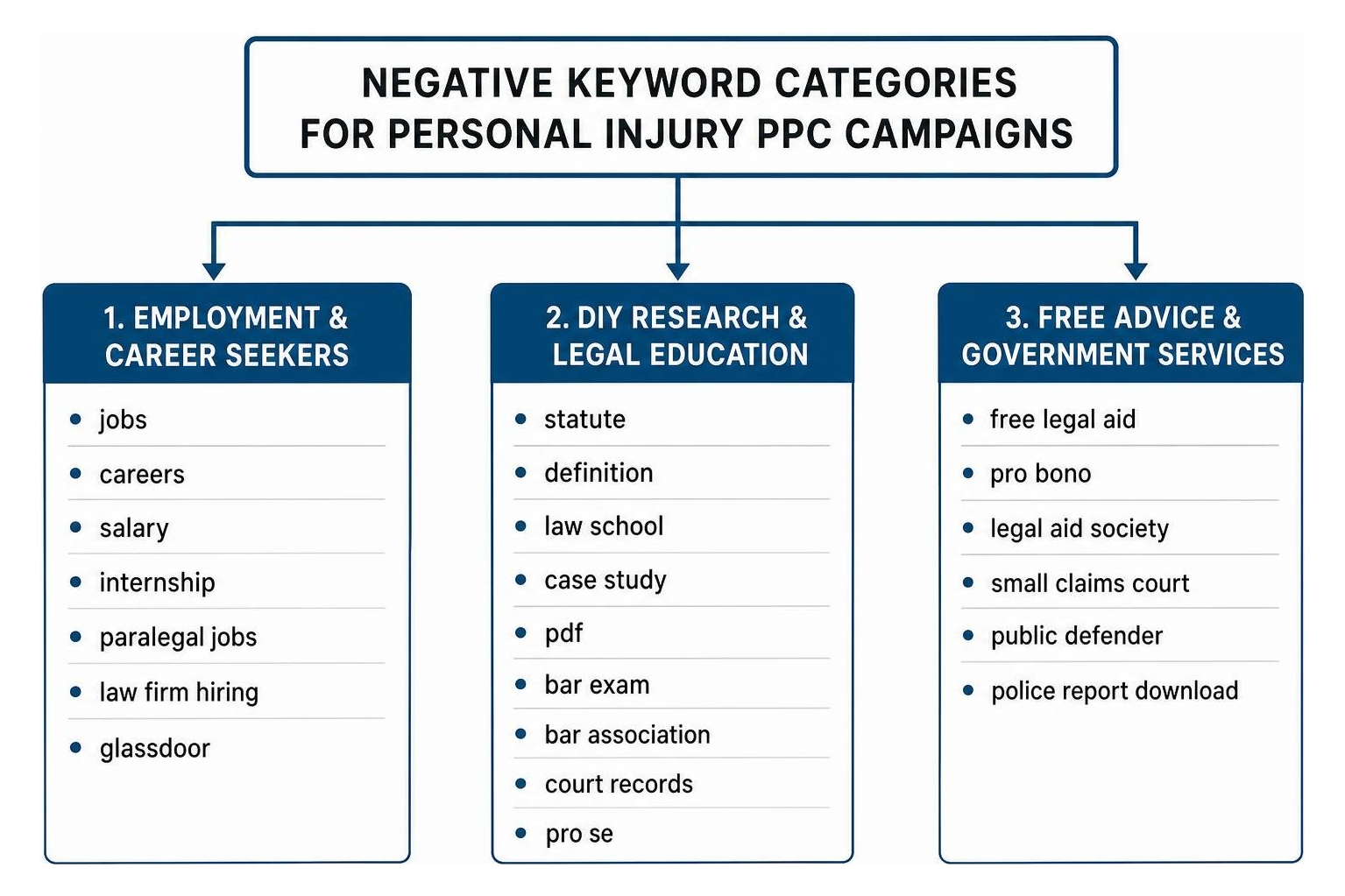
A comprehensive personal injury negative keyword list must proactively block non-client search intent across several categories:
- Employment & Career Seekers:
jobs,careers,salary,internship,paralegal jobs,law firm hiring,glassdoor. - DIY Research & Legal Education:
statute,definition,law school,case study,pdf,bar exam,bar association,court records,pro se. - Free Advice & Governmental Services:
free legal aid,pro bono,legal aid society,small claims court,public defender,police report download. - Defense & Insurance Intent:
insurance adjuster job,claims agent salary,defense lawyer,how to fight personal injury claim. - Unwanted Practice Areas:
criminal defense,divorce attorney,estate planning,bankruptcy lawyer,workers comp(if not handled). - Irrelevant Tools & Calculators:
settlement calculator excel,forum,reddit,quora.
Regularly audit your Search Terms Report weekly to discover emerging negative search queries and immediately add them to account-level negative keyword lists. To dive deeper into budget protection, review our guide on how to Stop Wasting Ad Spend with Expert Lawyer PPC Management.
High-Converting Landing Pages and Ad Copy Strategy

Sending paid search traffic to your law firm’s homepage is one of the fastest ways to destroy a personal injury PPC budget. Homepages are designed for general navigation, displaying multi-practice options, firm histories, and legal news blogs. An injured prospect who clicks an ad expecting help with a truck accident will bounce immediately if forced to hunt through a generic site structure.
A dedicated landing page must be built with a singular focus: converting a stressed user into a phone call or form submission within seconds.
Key elements of high-converting personal injury landing pages include:
- Message Match: The headline on your landing page must echo the exact headline and offer from the ad the user clicked.
- Above-the-Fold Value Proposition: Visitors must immediately see what you do, where you practice, and how to reach you without scrolling.
- Simplified Mobile Contact: Over 63% of Google searches occur on mobile devices. Ensure sticky “Click-to-Call” buttons remain visible at the bottom of the screen as users scroll.
- 3-Field Contact Forms: Keep lead forms short (Name, Phone Number, Brief Details). Every extra field reduces mobile conversion rates significantly.
- Immediate Trust Signals: Display settlement results, Google star ratings, industry awards, and client reviews prominently near the call-to-action (CTA).
- Page Speed Optimization: Pages that take longer than 3 seconds to load suffer severe bounce rate spikes. Optimize images and scripts to ensure lightning-fast mobile loading.
While general law firm websites convert around 2% to 4% of traffic, well-structured practice-specific landing pages regularly reach conversion rates between 8% and 15%. For comprehensive landing page strategies, read The Ultimate Guide to Personal Injury Lawyer Marketing.
Qualifying High-Intent Leads Through Personal Injury PPC Copy
Writing ad copy for personal injury PPC requires balancing two competing goals: maximizing click-through rate (CTR) while actively disqualifying unproductive clicks. Because you pay per click, receiving clicks from prospects with minor claims, no injuries, or property-only damage wastes ad spend.
Use pre-qualifying ad messaging to screen traffic before the click occurs:
- Emphasize Injury Requirements: Use copy such as “Injured in a Car Accident?” or “Hospitalized After a Crash?” rather than generic terms like “Need a Lawyer?”. This filters out users looking for property damage claims or fender-bender advice.
- Highlight Contingency Fees: Include “No Fee Unless We Win” to convert hesitant prospects, but pair it with qualifying language like “Serious Injury Representation.”
- Clear Call to Actions (CTAs): Use direct action language: “Call Our Injury Team 24/7” or “Free Consultation — Speak With an Attorney Now.”
All ad copy must comply with strict state regulatory guidelines and ethics rules regarding legal advertising. Avoid unverified claims such as “Best Personal Injury Lawyer” or guaranteed settlement amounts, which violate Google’s policies and State Bar ethics rules. Ad copy should be authoritative, helpful, and empathetic.
Smart Bidding and True ROI Measurement Beyond CPL

Google Ads offers sophisticated automated bidding algorithms, including Target CPA (Cost Per Acquisition) and Target ROAS (Return on Ad Spend). However, automated bidding is not a plug-and-play solution for personal injury accounts.
Automated bidding algorithms rely on statistical machine learning. For Google’s Smart Bidding models to accurately optimize auctions, a campaign typically needs a minimum volume of 30+ conversions per month (ideally 50+) within a consistent budget structure.
In early-stage campaigns or accounts with lower budgets, automated bidding often fails because conversion data is too sparse. In these situations, algorithms can make wild bidding swings, overspending on high-volume, low-intent terms.
Follow a phased bidding deployment strategy:
- Launch Phase (Manual CPC or Enhanced CPC): Start with strict Manual CPC or Maximize Clicks with bid limits to establish baseline search term data, tight negative keywords, and initial conversion metrics.
- Data Accumulation Phase: Maintain consistent daily spend until the campaign consistently captures 30+ qualified phone calls and form submissions monthly.
- Smart Bidding Transition: Gradually transition to Target CPA bidding, setting your initial target CPA 10% higher than your manual baseline to avoid choking campaign traffic while the algorithm adjusts.
When running localized legal campaigns in areas such as Broward County, Florida, cross-reference regional directories like Best Personal Injury Lawyers in Broward County, FL to evaluate local market visibility and competitive ad placement dynamics.
Tracking Metrics That Matter: Cost Per Retained Case
Measuring success solely on Cost-Per-Lead (CPL) or Click-Through Rate (CTR) creates a major disconnect between marketing metrics and legal business realities. A firm receiving 50 leads at $100 CPL ($5,000 total) might look successful on paper. But if zero of those leads turn into viable legal claims, the campaign’s true ROI is zero.
True performance tracking requires measuring Cost Per Retained Case (CPRC):
Cost Per Retained Case = Total Ad Spend / Total Signed Clients
To accurately measure CPRC, law firms must integrate Google Ads conversion tracking directly with dynamic call tracking platforms and legal intake CRMs.
Key steps for closed-loop conversion attribution include:
- Dynamic Number Insertion (DNI): Automatically displays unique telephone numbers on landing pages based on the visitor’s specific keyword and campaign session, connecting offline phone calls directly to ad clicks.
- Intake CRM Tagging: Tag leads in your CRM with their Google Click ID (GCLID) and source keywords. Mark leads as “Qualified,” “Signed Case,” or “Rejected.”
- Speed-to-Lead Workflows: Studies show that reaching out to an online lead within 5 minutes increases conversion rates dramatically. Personal injury prospects facing medical emergencies convert with the fastest responder. Ensure your intake phone lines are monitored live 24/7.
- Offline Conversion Tracking: Feed signed case data back into Google Ads via offline conversion imports. This teaches Google’s machine learning models which specific keywords generate actual fee-paying clients rather than just tire-kicker leads.
Frequently Asked Questions About Personal Injury PPC
Why is personal injury PPC so expensive compared to other verticals?
Personal injury PPC is highly expensive because potential case values and contingency fee revenues are extraordinarily high. A single major accident case can result in tens or hundreds of thousands of dollars in legal fees. Because the financial return on a signed client is so substantial, law firms compete aggressively in Google auctions, driving average national CPC costs up to $181+ for core terms.
Should personal injury law firms use automated bidding or manual CPC?
Law firms should start new or lower-volume campaigns using Manual CPC or Enhanced CPC to maintain strict control over keywords, bids, and search query quality. Once a campaign consistently generates at least 30 conversions per month, firms can safely transition to automated strategies like Target CPA to allow Google’s machine learning algorithms to optimize bid adjustments in real-time.
What is a realistic conversion rate for a personal injury landing page?
While standard legal websites convert traffic at 2% to 4%, dedicated personal injury landing pages built with tight ad relevance, clear trust signals, simplified forms, and mobile click-to-call buttons achieve conversion rates between 8% and 15%.
Conclusion: Elevating Your Firm’s Paid Search Performance
Dominating personal injury PPC requires far more than setting up a few keywords and launching standard search ads. In one of digital marketing’s most competitive environments, building a profitable campaign demands precise financial calculations, granular campaign architecture, hyper-local targeting, aggressive negative keyword protection, and dedicated landing pages built for instant conversion.
By monitoring true business metrics—specifically Cost Per Retained Case and long-tail fee revenue—your firm can transform paid search from an unpredictable expense into a predictable engine for revenue and firm expansion.
At BullsEye Internet Marketing, we deliver transparent, ROI-focused paid search management tailored to law firms seeking sustainable growth. We offer no long-term contracts and maintain a strict policy of working with only one client per industry per geographic area, giving your firm a true competitive advantage in your local market.
To refine your firm’s advertising strategy, discover key insights in An Essential Guide to Advertising for Lawyers, or reach out to our legal marketing team today to perform an audit of your Google Ads account.
