
Why Every Business Running Paid Ads Needs a PPC Audit Program
A PPC audit program is one of the most powerful tools you can use to stop wasting ad budget and start getting real results from your paid campaigns.
Quick answer: A PPC audit program is a structured, repeatable process for reviewing your pay-per-click campaigns — checking everything from conversion tracking and keyword strategy to bidding, targeting, and ad copy — to find waste, fix problems, and improve ROI on a consistent schedule.
Here’s what a PPC audit program covers at a glance:
| Area Reviewed | What It Checks |
|---|---|
| Conversion tracking | Accurate pixel firing, tag setup, GA4 alignment |
| Account structure | Campaign organization, naming, goal alignment |
| Keywords | Match types, negatives, Quality Scores |
| Bidding & budget | Strategy fit, wasted spend, allocation |
| Ads & extensions | Copy, assets, message match |
| Landing pages | Speed, relevance, CTA clarity |
| Targeting | Location, device, audience, scheduling |
The numbers are hard to ignore. Most ad accounts leak 10–30% of spend through tracking gaps, poor targeting, and loose structure. Some estimates put wasted spend even higher. That’s real money disappearing every month — often without any obvious warning signs inside your ad platform.
The problem is that most businesses only look at their campaigns when something goes wrong. By then, the damage is already done.
A structured audit program changes that. Instead of reactive fixes, you get a proactive system that catches issues early, keeps campaigns aligned with your business goals, and compounds improvements over time.
I’m Ronnie Katz, founder of BullsEye Internet Marketing, and since 2006 I’ve helped businesses recover wasted ad spend and grow revenue through disciplined PPC audit program processes built on over 20 years of hands-on paid search experience. In this guide, I’ll walk you through everything you need to build or improve your own audit program — so your campaigns work harder without spending more.
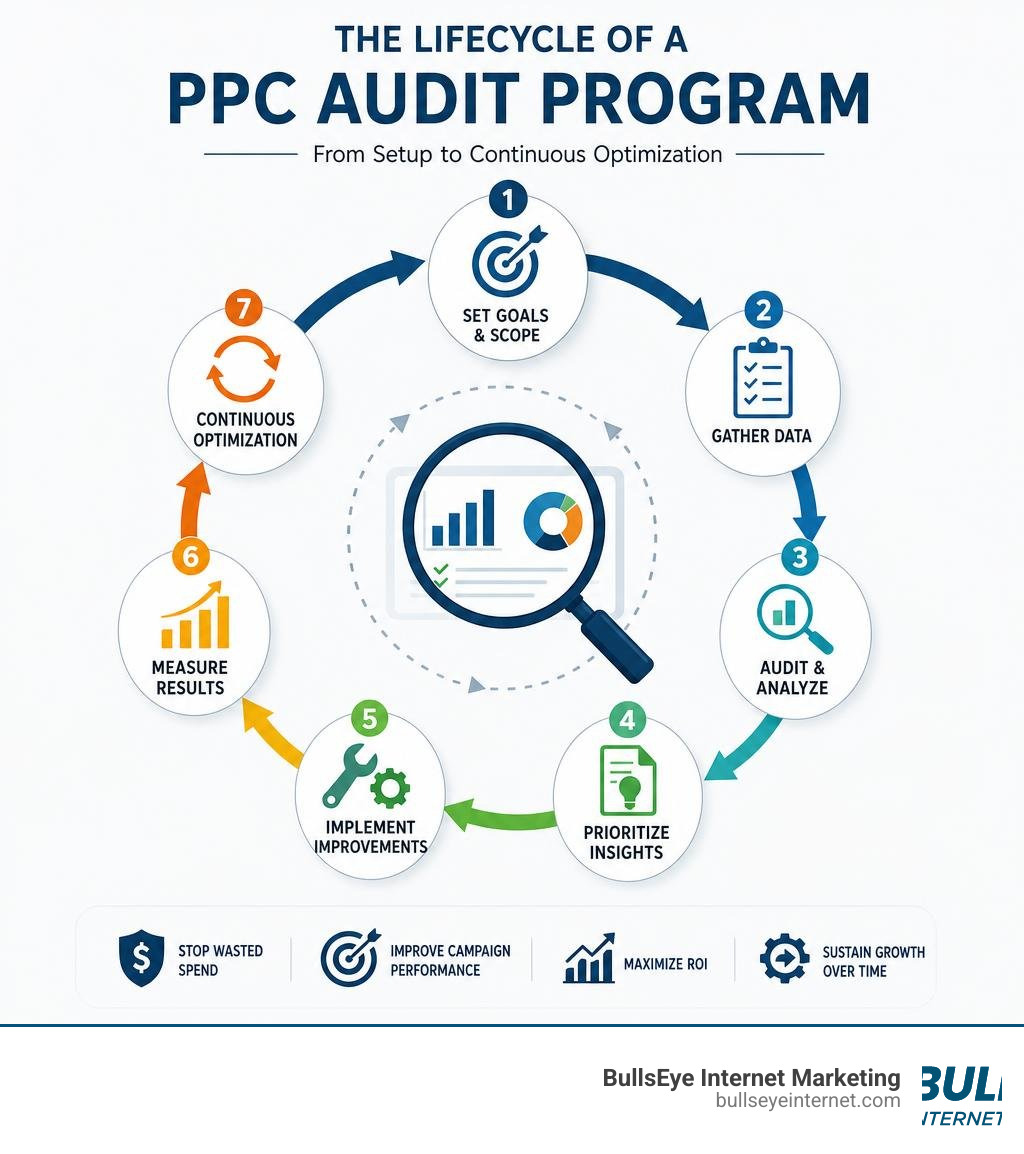
Ppc audit program terms explained:
What is a PPC Audit Program and How Does It Differ from a Standard Audit?

When most marketers hear the word “audit,” they picture a stressful, one-time event — like scramble-cleaning your house right before your in-laws arrive. In the digital marketing world, a standard PPC audit is often just that: a single, ad-hoc checkup performed when performance takes a nosedive or when onboarding a new agency.
A PPC audit program, on the other hand, is a continuous, structured framework. It moves away from the “set-it-and-forget-it” mentality and establishes a systematic rhythm for campaign evaluation. Think of a standard audit as a medical checkup when you’re already feeling sick, whereas an audit program is your ongoing fitness and nutrition regimen that keeps you healthy in the first place.
To help visualize this shift, let’s look at how they compare side-by-side:
| Feature | Standard PPC Audit | Structured PPC Audit Program |
|---|---|---|
| Frequency | Ad-hoc (usually when performance drops) | Scheduled (monthly sweeps, quarterly deep dives) |
| Focus | Quick fixes and immediate pain points | Long-term strategy, compliance, and structural health |
| Data Scope | Typically the last 30 to 90 days of data | Year-over-year trends and cohort data patterns |
| Integration | Standalone document or slide deck | Embedded in weekly and monthly workflows |
| Ownership | Often outsourced or done by a single specialist | Shared accountability across the account team |
Implementing a continuous program ensures that your account health is monitored proactively. If you want to understand the foundational elements of how we dissect accounts, explore our Unlock Your PPC Potential: A Comprehensive Account Audit Guide.
Transitioning from Ad-Hoc Reviews to a Continuous PPC Audit Program
Making the leap from chaotic, ad-hoc reviews to a structured program is all about establishing campaign governance. When you rely on ad-hoc checks, minor inefficiencies easily slip through the cracks. Over time, these small leaks — like a rogue broad match keyword or an accidental location setting — can compound into thousands of dollars of wasted ad spend.
By building a continuous audit program, we establish clear rules for account hygiene. This means setting up automated scripts to check for broken URLs, scheduling regular search term reviews, and conducting peer-to-peer audits within your team. A fresh set of eyes can spot subtle performance issues that the primary account manager might miss. To understand the step-by-step mechanics of how to run these evaluations systematically, take a look at our guide on PPC Audit Methodology 101.
Core Components and Deliverables of an Effective PPC Audit Program
An effective PPC audit program isn’t just a list of suggestions; it is an operational engine. To drive real results, your program must produce clear, actionable deliverables at every stage.

The core components of an enterprise-level audit program include:
- Tracking and Attribution Validation: Ensuring your tracking pixels and conversion setup are 100% accurate.
- Structural Integrity Analysis: Checking campaign settings, naming conventions, and asset distributions.
- Keyword and Intent Alignment: Assessing search terms, negative lists, and keyword match types.
- Creative and Asset Performance: Evaluating ad copy, ad strength, and ad extensions.
- Post-Click Experience Review: Auditing landing page load speeds, mobile responsiveness, and message match.
A major focus of any modern audit must be the technical tracking pipeline. If your conversion tracking is broken, ad platform algorithms will optimize for the wrong actions. According to industry data, inaccurate conversion tracking shows up in 70% to 80% of audited accounts. For a highly detailed look at how to audit your technical tracking setup in 2026, check out The 10-Point PPC Audit Checklist for 2026: A Deep Dive | Trackingplan.
To make these findings digestible for stakeholders, we always recommend translating raw data into a clean, visual report. To build one yourself, refer to our resource on Beyond the Numbers: Your Guide to a Winning PPC Audit Report Template.
Integrating Your PPC Audit Program with Existing Workflows and Tools
An audit program shouldn’t feel like extra homework for your marketing team. For it to succeed, it must integrate seamlessly with your weekly and monthly workflows.
Modern teams use a mix of automated scripts, platform-native rules, and third-party software to handle the heavy lifting. For instance, you can use automated scripts to run daily checks for broken landing pages, while using budget-pacing tools to prevent overspending. By automating the data collection process, your team can focus their energy on strategy and execution. To see which tools can streamline your process, explore our breakdown of From Manual to Magical: Top Tools for a Flawless PPC Audit.
Key Metrics and KPIs Tracked by the Program
Your audit program must track metrics that directly impact your bottom line. While click-through rates (CTR) and cost-per-click (CPC) are helpful, we focus heavily on downstream conversion tracking and business value.
- Quality Score: This is Google’s way of measuring ad relevance. Better-structured accounts show Quality Scores around 7/10 or higher. Improving your Quality Score can lead to a 20% to 40% lower CPC.
- Return on Ad Spend (ROAS): Are your campaigns actually profitable? We look at blended ROAS and contribution margins to ensure your budgets are allocated efficiently.
- Conversion Rate (CVR) and CPA: We cross-reference ad platform data with your CRM to identify discrepancies. If your platform reports 100 conversions but your CRM only shows 50 qualified leads, you have a tracking or lead quality issue that needs immediate attention.
To keep your campaigns in peak condition, read our guide on how to Keep Your Campaigns Thriving: A Google Ads Health Checkup.
Execution Frequency: When to Trigger Full vs. Targeted Audits
How often should you run your audit program? The sweet spot is a tiered frequency strategy:
- Monthly Hygiene Sweeps: A quick check of conversion pixels, budget pacing, location targeting settings, and search term reports to add negative keywords.
- Quarterly Deep Dive Audits: A comprehensive 44-to-60 point check of the entire account structure, competitor landscape, landing page conversion rate optimization (CRO), and smart bidding performance.
- Trigger-Based Audits: These are targeted audits launched in response to specific events, such as:
- Onboarding a new client or hiring a new team member.
- Launching major new seasonal campaigns.
- Sudden, unexplained drops in conversion volume or spikes in CPA.
- Preparing for peak sales seasons (like Q4 retail or summer home services).
By keeping a regular schedule, you ensure your campaigns are optimized to capture traffic spikes and maximize conversions when it matters most. If you need a manual to get started, walk through our Step-by-Step Guide to Performing a PPC Audit.
Identifying Common Waste Areas and Tailoring the Program
One of the primary goals of a PPC audit program is to eliminate wasted ad spend. On average, accounts can leak 10% to 30% of their budget (and sometimes much more) due to simple configuration mistakes.
The most common waste areas we uncover include:
- Broad Match Run Amok: Running broad match keywords without a robust negative keyword list, causing your ads to show for completely irrelevant searches.
- Geographic Targeting Missteps: Leaving targeting set to “Presence or Interest” instead of “Presence.” If you are a local service business in Fort Lauderdale or West Palm Beach, you don’t want to pay for clicks from users in New York who are simply “interested” in your area.
- Search Partner Network Bloat: Spending budget on low-quality search partner websites that drive high clicks but zero conversions.
- Cannibalization: Performance Max campaigns accidentally bid on your own branded keywords, inflating your conversion numbers while wasting budget on users who would have clicked your organic listings anyway.
To see how we map out these waste sources and turn them into savings, read Performance Marketing Audit: Your Roadmap to Smarter Ad Spend.
Best Practices and Checklists for Consistent Execution
To make sure your audit program runs smoothly and consistently, your team needs a clear, standardized checklist.
Key best practices include:
- Strict Match Type Management: Documenting why specific match types are used and maintaining shared negative keyword lists across all campaigns.
- Location Targeting Audits: Regularly auditing user location reports to exclude underperforming zip codes or cities.
- Landing Page Testing: Running regular page-speed checks and message-match audits to ensure your ads align perfectly with your landing pages.
For a comprehensive list of checks you can implement today, see our Ultimate Checklist for Your Adwords Audit Service.
Measuring the ROI and Long-Term Impact of Your Audit Program
Just as corporate financial teams rely on structured frameworks like Our PPC audit guides – Thomson Reuters to ensure financial compliance and prevent capital waste, digital marketing teams must use structured PPC audit programs to protect their ad capital.
The ROI of an audit program is measured by tracking key performance improvements over time:
$$text{Audit Program ROI} = frac{text{Wasted Spend Saved} + text{Value of Extra Conversions}}{text{Cost of Program Execution}}$$
By systematically identifying underperforming keywords, fixing tracking gaps, and optimizing landing pages, you will see a steady decline in your cost per acquisition (CPA) and a healthy rise in your conversion rates. Over time, these optimizations compound, allowing you to scale your campaigns profitably without needing to continuously increase your budget.
To understand the financial impact of professional oversight, read Maximize Your ROI: Why a Professional PPC Audit Service Is Essential.
Frequently Asked Questions about PPC Audit Programs
How long does a full PPC audit take to complete?
The duration of an audit depends entirely on account complexity and data volume. For smaller local accounts spending under $10,000 per month, a thorough audit can take 4 to 8 hours. For larger, multi-channel enterprise accounts with complex offline conversion tracking and CRM integrations, it can take anywhere from 12 to 20 hours of dedicated analysis.
What is the most common issue uncovered during a PPC audit?
By far, the most common issue is broken or incomplete conversion tracking. This includes duplicate tracking tags, tracking simple page views as primary conversions, missing phone call tracking, and discrepancies between Google Ads and Google Analytics 4 (GA4).
Should Performance Max campaigns be audited differently?
Yes. Because Performance Max relies heavily on Google’s machine learning, you cannot audit it using traditional keyword-level methods. Instead, you must audit the quality of your asset groups (images, copy, video), the strength of your audience signals (first-party data lists), and look closely for brand cannibalization in your search term insights.
Conclusion
Building a structured PPC audit program is the single best way to protect your marketing budget and ensure your paid campaigns deliver measurable business growth. Instead of waiting for performance to drop, a continuous audit program keeps your campaigns lean, highly targeted, and aligned with your bottom-line financial goals.
At BullsEye Internet Marketing, we specialize in helping businesses across South Florida — from Miami and Broward County up through Palm Beach and Martin County — maximize their ad spend. We do things differently: we offer no long-term contracts and work with only one client per industry per geographic area, giving you a massive competitive advantage in your local market.
Ready to stop wasting ad spend and scale your leads? Contact us today to learn more about our BullsEye Internet Marketing PPC Services and let’s optimize your campaigns together!
